Security | Threat Detection | Cyberattacks | DevSecOps | Compliance

Security Interviews Should Leave Room for What Remains Unknown

An incident story can sound impressively clear once everyone knows how it ended. The suspicious login becomes an obvious warning, the escalation looks inevitable, and the response appears to follow a straight path. A security interviewer needs to look earlier in the story, when the candidate had incomplete information and still had to choose what to do.


AI for Career Development: From Skill Assessment to Professional Growth

Most professionals don't have a clear picture of how their skills compared to what employers are actually looking for. This is a gap that career coaching has traditionally tried to fill, but the process was often slow and based on limited information. AI now makes it possible to assess your skills accurately and get direct, data-backed guidance on what to improve. In this article, we'll look at how AI is changing skill assessment, professional growth, and the broader career development process - from the moment you evaluate your abilities to the moment you land a role that actually fits.

Bitdeer Extends Its Infrastructure Strategy From Bitcoin Mining to Full-Stack AI Cloud and Model Studio

Every mining cycle returns to the same unromantic question: what does one megawatt earn after the electricity bill? As hashprice narrows the margin on mining hardware, AI workloads offer power-rich operators another source of revenue. Bitdeer's move into full-stack AI Cloud is therefore less a change of identity than a change in how infrastructure gets paid.

CVSS Measures Severity. Risk Requires Context.

CVSS remains a valuable tool for understanding vulnerability severity, but severity and risk are not the same. In this video, we explore why effective risk management requires additional context, including asset reachability, business impact, remediation timelines, and an organization's ability to reduce exposure. CVSS can help start the conversation, but it shouldn't be the only factor driving prioritization decisions.

List of Best VMware Alternatives in the UAE

If you're a CIO in the UAE, you've probably had at least one conversation this year about what happens after VMware. Broadcom's licensing changes shook up a lot of long-term customers, and plenty of IT teams here are quietly running the numbers on what a move would cost. The good news is you're not short on options. The tricky part is that "VMware alternatives" in the UAE cover two different paths, and mixing them up leads to messy decisions.

How to secure Exchange Server beyond the CVE-2026-62911 fix

Remote access has always been a core part of how on-premises Exchange works. Users need OWA to read their email from outside the office. Their devices need Autodiscover to set themselves up automatically. Keeping both reachable means keeping Exchange accessible from the Internet, and that opens up more of the server than most organisations realise. CVE-2026-62911 is the latest example. Microsoft released the fix on August 11, 2026.

How to Mark and Label CUI Correctly for CMMC

CMMC is vast and complex, but when you drill down to the heart of it, it's all about one thing: properly securing CUI. And yet that, in and of itself, is a problem. All CUI needs to be marked, which means if you receive CUI from your agency or prime, it needs to be properly marked. And it means if you produce CUI, you need to mark it properly yourself. How do you know what is and isn't CUI, and how do you mark it properly? What happens if you get it wrong?

Stopping Data Exfiltration From Departing Employees

Departing employees still email files to personal accounts and copy them to USB drives. Now they also paste sensitive content into ChatGPT, Claude, or Gemini to summarize a codebase, draft a portfolio piece, or package a project before their last day. Neither channel has replaced the other. The attack surface has simply gotten wider, and most security teams are still staffed and tooled for the channels they already know how to watch.

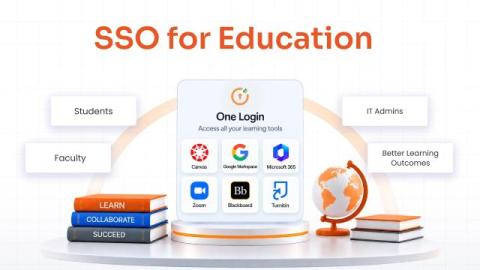
SSO for Education: Secure and Simplify Access to Learning Applications

Students, teachers, and faculty now move across a growing stack of learning, collaboration, communication, and administrative applications. Every new platform can mean another login to remember and another account for IT teams to manage. That creates friction for users and a growing access-management burden for institutions. SSO for education brings these applications behind a central authentication layer, allowing users to access authorized services with one institutional identity.

Cloud Infrastructure Entitlement Management (CIEM): A Complete Guide

In the cloud, an identity is no longer necessarily a person. It can be an application calling an API, a workload accessing storage, a service account running an automated process, or a machine interacting with another cloud resource. Each needs permissions to operate, and each becomes part of an access environment that changes as quickly as the infrastructure itself. This has expanded identity security beyond managing users and accounts to governing a much larger ecosystem of human and non-human access.