Security | Threat Detection | Cyberattacks | DevSecOps | Compliance

How Does DLP Detect Data Exfiltration

Most data exfiltration does not look like a policy violation while it is happening. An employee moves a file to a personal cloud account they use every day. A contractor pastes source code into a chatbot to get help debugging. An AI agent with standing access to a shared drive pulls a document into a workflow no one is watching. None of it trips a keyword match, because none of it was written with a banned word in the payload.

Data Discovery vs. Data Classification

Most DLP rollouts stall in the same place. The classifier flags a file as "confidential," but nobody, including the DLP solution itself, can say why, where it came from, or whether that label still matches what's inside the file six months later. Data discovery and data classification get bundled together in nearly every vendor pitch, but they solve different problems, and the gap between them is where false positives, stale labels, and missed exfiltration events live.

You Can Automate Data Security Workflows. You Can't Automate Accountability.

The most pressing security question isn't whether AI will automate your workflows. It's what remains once it does. The answer, consistently, is judgment, and judgment has always belonged to a human. The SEC charged SolarWinds' CISO personally for misrepresenting the company's cybersecurity practices. Uber's CISO was convicted of a federal crime for concealing a data breach.

How Data Security Fits Into a Data Management Framework

Most data management frameworks list security as one component among several, including governance, quality, integration, retention, architecture, and analytics. Security is often treated as an equally weighted checkbox on the same list as the others. That framing is where data security programs start to break down.

Data Lineage vs. Data Provenance: What's the Difference?

Security and governance teams often use "data lineage" and "data provenance" as if they have the same definition and offer the same insights. They don't, and the gap between them shows up fast once a program tries to act on it. A provenance record can tell you where a file came from, but it cannot tell you what happened to it after an employee copied it into a new spreadsheet, renamed it, and uploaded it to a personal cloud drive.

Beyond Firewalls: The Role of Physical Security in Data Protection

When we talk about data protection, we almost always focus on the digital side. We discuss firewalls, malware, phishing scams, and encryption. While these digital defenses are definitely crucial, they're only half the story. A locked digital door doesn't help if an intruder can just walk in physically and take the server. Real data security needs a strategy that goes beyond the screen and into the physical world where your data actually lives.

How to Prevent AI Agents from Exfiltrating Sensitive Data

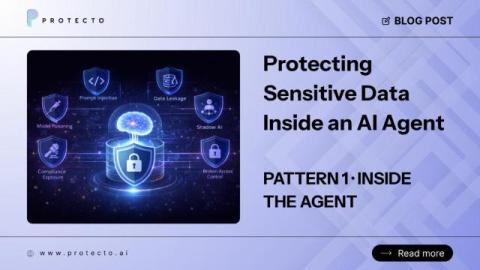
An AI agent on a developer's laptop has read access to a code repository, a set of internal documents, and an external model. Nobody approved that specific combination, and nobody is watching what the agent does with it session to session. The agent is not malicious, however, it is doing exactly what it was configured to do. But, that configuration is the exposure, and most security teams do not have a way to see it, let alone stop it before sensitive data leaves the environment.

Agentic AI Governance Requires a New Enforcement Model

AI has swiftly shifted from a browser-based chat interface to an autonomous actor operating within enterprise environments. Agents run locally on endpoints, inherit employee permissions, access sensitive data in bulk, and execute multi-step workflows with no human approving each step. That shift fundamentally changes the enforcement surface. The governance programs most organizations have built were designed for a different model: one user, one prompt, one decision.

How to Protect R&D Data During M&A

Mergers and acquisitions (M&A) concentrate risk into a narrow window. The moment a deal is announced, employees with access to proprietary research, source code, and unreleased product plans face pressure and opportunity at the same time. Some update their resumes. A smaller number decide to take something with them: a research file, a pricing model, or a customer list before the transition is final. For compliance and security teams, the challenge goes beyond stopping data exfiltration.

Microsoft Purview DLP Limitations and How to Close Them

Security teams that roll out Microsoft Purview DLP inside their Microsoft ecosystem often assume coverage extends further than it does. Policies apply cleanly to Word, Excel, and Outlook. Then a sensitive.dwg is inspected only by extension because Purview doesn't scan CAD content, a developer on a Linux workstation falls outside endpoint coverage entirely, or raw source code moves to a USB drive without matching the source-code classifier, which runs on the endpoint only for Office and PDF files.