Security | Threat Detection | Cyberattacks | DevSecOps | Compliance

The latest News and Information on Data Security including privacy, protection, and encryption.

Data Sovereignty vs. Data Residency: Key Differences Explained

Storing data in a specific country doesn’t automatically mean that that country’s laws are the only ones that apply. This disconnect catches a lot of organizations off guard, and it’s exactly where the confusion between data sovereignty vs. data residency begins. One is about where your data physically lives. The other is about which laws govern it, regardless of location.

Why Endpoints are Still a Data Security Problem in the Age of AI

After decades of innovation in personal technology, ranging from watches that track personal fitness, mini super-computers that we call phones, and a whole host of other gadgets and self-help technologies, our companies still rely on one technology that started over 45 years ago – the laptop. Fun fact: the first one, called the Osborne 1, weighed 24 pounds! The modern laptop has a better screen, longer battery life, and weighs significantly less, but at its core is still a hard drive.

Data Leak iPhone: Causes, Risks, and How to Protect Your Data

In 2023, the FBI's Internet Crime Complaint Center recorded over 880,000 complaints, with billions lost. Many began with small actions on a phone. A data leak on iPhone often stems from user behavior like missed updates, weak passwords, or phishing links, rather than the device itself.

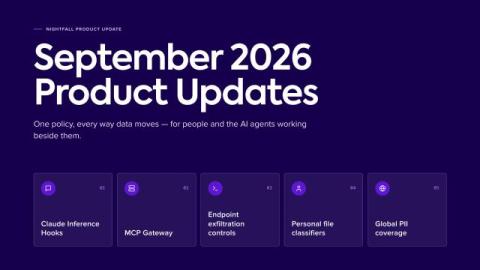
AI Agents are moving your sensitive data: Nightfall built a solution where DLP fails

Somewhere in your environment right now, an AI agent is reading files, querying a database, and passing output through a channel your DLP has never seen. It's running under a legitimate user credential, inside a sanctioned tool, and it will not trigger a single alert. When it's done, there will be no record of what it accessed or where that data went. This is not an edge case. It is the default state of most enterprise environments in 2026.

You Can't Secure AI Agents You Haven't Found

Most organizations have a reasonable handle on their sanctioned SaaS apps. Model Context Protocol - hit 10,000 public servers within a year of launch, with 97 million monthly SDK downloads. None of those numbers capture the servers your developers configured locally. Those don't appear in any registry. They were added at the IDE level, one developer at a time, with no approval step and nothing that touches a central system. That's the inventory problem. It comes before any question of enforcement.

How Do AI Agents Create Data Exfiltration Risk?

AI agents create data exfiltration risk by combining three capabilities that are dangerous together: access to private data, exposure to untrusted content, and the ability to communicate externally. When all three exist in one agent, an attacker can hide instructions inside an email, document, or webpage the agent processes and trick it into sending sensitive data out. No software vulnerability is required. The attacker doesn't need to break in. They just need to talk to your agent.

NSW Treasury Breach, ABAC, and Principles of Least Privilege

Recent headlines heralded another unfortunate security breach: an employee of the NSW Treasury in Sydney, Australia, illegally downloaded more than 5,600 sensitive government documents, which were later recovered at his home. This was labeled a “significant cyber incident” by the NSW government and had been detected by an internal security monitoring tool that detected “movement of a large cache of documents”.

After the Vercel Breach, Do You Know What Your AI Tools Can Access?

In April 2026, Vercel disclosed that attackers had accessed internal systems and customer credentials — not by breaking into Vercel directly, but by compromising a third-party AI tool one of its employees had connected to their corporate account.

Understanding DISP Membership and Requirements in the Defence Industry Security Program

If you work with the Australian defence sector, DISP membership is no longer optional. The Defence Industry Security Program (DISP) is a baseline requirement for organisations operating in or supplying into Australian Defence. Most companies still treat DISP in defence as a compliance checkbox, but that approach fails. DISP is about reducing real operational risk across the supply chain.