Security | Threat Detection | Cyberattacks | DevSecOps | Compliance

The Security Trifecta: Operationalizing API Protection with AWS, Wallarm, and Coralogix

In the modern digital world, API’s are no longer just “connectors” – they are the real security product. Whether you are a Fintech processing payments, a SaaS platform managing multi-tenant data, or an E-Commerce giant handling the bulk of sales, your API’s are the foundation of your customer registration, checkout experiences, and partner ecosystems. However, that transition has made API’s the fastest-growing attack surface in history.

Kling Video 2.6 API: How to Build Automated Visual Simulation Workflows

The landscape of generative media has shifted from simple prompt-based experimentation to sophisticated, integrated production pipelines. With the release of Kling 2.6, the focus has moved toward "Native Audio-Visual Generation"-a breakthrough that allows developers to synchronize high-fidelity visuals with context-aware sound in a single automated step. For platforms focusing on digital senses and technical security, the Kling Video 2.6 API offers a robust framework for building simulations that were previously too resource-intensive to automate.

6 Lessons Security Leaders Must Learn About AI and APIs

Most organizations treating AI security as a model problem are defending the wrong layer. Security teams filter prompts, patch jailbreaks, and tune model behavior, which is all necessary work, while the actual attack surface sits largely unexamined underneath. That surface is the API layer: the endpoints AI systems use to retrieve data, call tools, and take action on behalf of users. This isn't a theoretical gap.

You're Not Watching MCPs. Anthropic's Vulnerability Shows Why You Should Be.

Last week, researchers at OX Security published findings that should stop every security leader in their tracks. They discovered a critical vulnerability baked directly into Anthropic's Model Context Protocol SDK, affecting every supported language: Python, TypeScript, Java, and Rust. The result: remote code execution on any system running a vulnerable MCP implementation, with direct access to sensitive user data, internal databases, API keys, and chat histories. Over 7,000 publicly accessible servers.

Attacking the MCP Trust Boundary

Every secure API draws a line between code and data. HTTP separates headers from bodies. SQL has prepared statements. Even email distinguishes the envelope from the message. The Model Context Protocol (MCP), the fast-growing standard for connecting AI agents to external services, inherits that gap from the models it sits on top of.

The Governance Gap: How the EU AI Act Makes API Security a Compliance Imperative

Your legal team just handed you a 400-page document and said "figure out compliance." The EU AI Act is live, your organization falls under its scope, which is broader than many expect. Even non‑EU companies must comply if their AI systems are used, deployed, or produce effects within the European Union. In practice, that means that global organizations building or integrating AI models cannot treat the Act as a regional regulation.

Why API Discovery Is the First Step to Securing AI

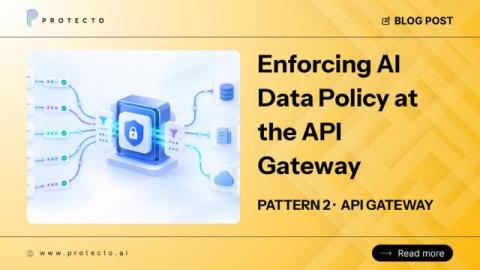
AI risk doesn’t live in the model. It lives in the APIs behind it. Every AI interaction triggers a chain of API calls across your environment. Many of those APIs aren’t documented or tracked. That’s your real exposure. Shadow API discovery gives you visibility into those hidden endpoints, so you can find them before attackers do. If you don’t know which APIs your AI relies on, you can’t secure the system.

Claude Mythos Changed Everything. Your APIs Are the First Target.

Anthropic just released Claude Mythos Preview. They did not make it publicly available. That decision alone should tell you everything you need to know about what this model can do. During internal testing, Mythos autonomously discovered and exploited zero-day vulnerabilities across every major operating system and web browser. It found a 27-year-old bug in OpenBSD. A 16-year-old vulnerability in a widely used media codec.

Everyone Is Securing the Wrong Layer of AI

The AI security market is crowded. Vendors are racing to protect prompts, harden models, detect jailbreaks, and scan for data leakage at the LLM layer. The investment is real. The intent is good. And most of it is missing the point. Here is the problem: agents do not just think. They act. They call APIs. They trigger workflows. They write to databases, send emails, move money, and modify production systems.