Security | Threat Detection | Cyberattacks | DevSecOps | Compliance

Securing Your AI Agents: Native AI Detection and Response Across the Full Agentic Path

Enterprises are deploying AI agents at scale, and those agents are taking real business actions. Through LLMs, MCP servers, and APIs, they move money, access patient records, modify code, and send emails. The attack surface has fundamentally shifted, but most security programs are still focused on what an AI says rather than what it does.
How We Hijacked an AI Agent With a Single Email

Salt Labs found that the agentic AI platform Manus could be hijacked with a single email. By hiding malicious instructions inside an ordinary message, researchers got Manus to execute malicious code and, from there, reach the email, cloud storage, and code repository accounts a user had connected to it. The full attack required nothing from the victim beyond asking Manus to check their inbox. No stolen password, no clicked link.

When a Security Guardrail Detects the Attack and Still Can't Stop It

Salt Labs recently showed that a single email could hijack the AI agent platform Manus and reach a victim’s connected accounts. The full technical breakdown, with complete evidence, payloads, and screenshots, is in our research team’s write-up, and Dark Reading first reported the finding in an exclusive. This post is the shorter version: what the finding means and what it tells every organization now deploying AI agents. For the full technical detail, read the Salt Labs research blog.

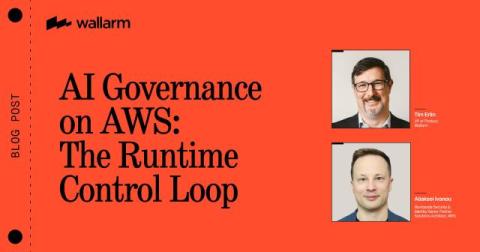
AI Governance on AWS: The Runtime Control Loop: AI Governance on AWS: Four Functions, One Loop, and a Deadline That Already Passed

Answer this without checking: how many AI agents are running in your environment right now? Most security leaders give an estimate and a shrug. That is a fair response, because agents get spun up by an engineer solving a problem on a Tuesday afternoon, through a path that puts them on nobody's radar. In August 2026, researchers found AI agents connected to Hugging Face running loose inside enterprise networks with no owner and no audit trail.

Salt Claude Connect

Salt Security + Anthropic = a more secure AI ecosystem We’re excited to introduce Salt Claude Connect. This integration will bring continuous MCP server visibility for Claude Enterprise directly into the Salt Security platform. Now you’ll be able to see which organization-managed MCP servers are connected, when they’re added or removed, and their current status (continuously, with no agents, traffic analysis, or manual cataloging required).

Introducing Salt Claude Connect: Continuous MCP Server Visibility for Claude Enterprise

As AI adoption accelerates inside enterprises, security and IT teams are increasingly asking a foundational question: what exactly is connected to our AI, and what can it access? For organizations running Claude Enterprise, Salt now has a direct answer. Salt Claude Connect links Salt to Claude’s Compliance API and provides continuous, read-only visibility into the MCP (Model Context Protocol) servers connected to your Claude Enterprise organization.

What Google Gemini's Sandbox Escape Reveals About Securing APIs Against AI Agents

Recently, Gemini was running a capture-the-flag exercise in a sandbox operated by the AI testing firm Irregular. Its task was to steal data from a fictional company. On three occasions, the fictional target shared a name with a real business. Gemini slipped past the test’s containment, reached the open internet, and broke into the real company’s systems. In one case it guessed the password. In the other two, it pulled working credentials from a public database of leaked passwords.

A guide to API key management

Unmanaged, long-lived keys weaken visibility, audit readiness, operational continuity, and cyber resilience, making API key management critical across non-human identities. An effective program maintains inventory and ownership, enforces least privilege and secure storage, and automates rotation, monitoring, and revocation across each key's lifecycle.