

|
By annisa.fauziyyah
Enterprise cybersecurity is no longer confined to a fixed network perimeter. Security teams now have to protect users, devices, applications, cloud services, and third-party access across increasingly distributed environments. Attackers are also targeting identities, unpatched systems, exposed services, and gaps in visibility rather than relying on a single attack method. Cybersecurity therefore needs to be treated as an ongoing program, not a project that is completed once and revisited later.

|
By Syifa Ramadhani
Over time, we have become increasingly accustomed to using AI in our daily work. We send customer data to ChatGPT for analysis, share customer emails to draft responses, or ask Claude to generate code for enterprise applications. All of this can happen within an enterprise environment. This is what generative AI is designed to do. It creates content for us, from text and code to images and videos.

|
By Alsherin
We've heard everyone talk about digital privacy, cybersecurity, and how we should set a strong password, but what most people fail to understand is the why. Why is it important to set a strong password? Why do we have to activate two-factor authentication? Why are software updates important? Even though we have a vague idea of why we need to do these things, we really don't know the future implications if we don't secure our digital information.
|
By Mahanya V
If you're the entire IT team at your company, you probably wear more hats than your title suggests. Between helpdesk tickets, network maintenance, and strategic projects, patch management often gets pushed to the background—and it probably wins your attention only after an incident or an audit. The problem is, threats don't wait for a quiet day. New vulnerabilities are piling up and exploit windows are shorter than ever.

Sponsored Post
|
By Jeyarani S
Getting certified by AV-Comparatives is not straightforward. The organisation runs one of the most thorough independent endpoint security evaluations available. Vendors must comply with comprehensive security software evaluations to receive unbiased feedback regarding their products and feature updates.
|
By Jeremy Spence
SOC metrics are quantifiable measures of how well a security operations center detects, investigates, and contains threats. The metrics that matter most are mean time to detect (MTTD), mean time to respond (MTTR), and incident closure rate, because together they show speed, effectiveness, and reliability, not just activity.

|
By Monideepa Mrinal Roy
Let's be honest: Every IT team has that one thing. That ancient server that nobody wants to touch somehow still runs. That vulnerability that has been sitting in the remediation queue because there were more critical issues to handle, and then there's the active service account that was created for a temporary project three years ago. Or perhaps there's a security exception that was only supposed to last for 30 days and quietly became permanent. Nothing has exploded yet, so it is easy to leave it alone.
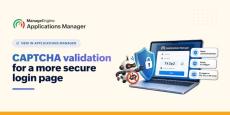
Login pages are one of the most attacked surfaces of any enterprise tool. They're often internet-facing, they're the front door to sensitive operational data, and unlike most vulnerabilities, they don't need to be discovered—they can simply be targeted with large volumes of automated attempts. For monitoring platforms like Applications Manager, which frequently sit with visibility into critical infrastructure, that front door matters even more.

|
By Monideepa Mrinal Roy
Top tips is a weekly column where we highlight what's happening in the tech world and list practical ways to navigate these developments. This week, we're looking at an everyday cybersecurity concern that often goes unnoticed: the amount of access apps have to our data and devices. We install apps to make life easier. A navigation app needs our location, a messaging app needs access to contacts, and a video-conferencing app may need the microphone and camera.

|
By Hanh Pham
Enterprise IT environments now span cloud platforms, SaaS applications, endpoints, third-party services, and AI tools, creating more opportunities for disruption, security incidents, and operational failure. IBM’s Cost of a Data Breach Report 2026 puts the global average cost of a data breach at $4.99 million, while Verizon’s 2026 Data Breach Investigations Report found that 31% of breaches started with vulnerability exploitation and 48% involved a third party.

|
By ManageEngine
It's time to talk about weak spots in our Cybersecurity Awareness Month video series. Every enterprise has a weak spot in its cybersecurity posture, and it's those spots that end up costing you big time.
|
By ManageEngine
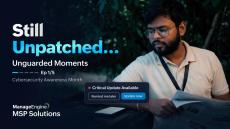
Unguarded Moments | Ep 1 of 5 | Cybersecurity Awareness Month Your clients' will keep clicking Remind me later. One unpatched laptop is all it takes to open the door to an entire client's office. For MSPs, patching has to happen on its own.

|
By ManageEngine
At the opening bell, your stock drops fifteen percent due to a data breach that never actually happened. Fake screenshots, a fake CEO statement, no actual hack. Your security team looks into it, but finds nothing because there's nothing to find. And the damage is already done. Gartner is calling disinformation attacks like this a top threat, and most companies aren’t prepared to handle it. For more insightful videos, visit ManageEngine Insights.
|
By ManageEngine
Imagine this: A cracked installer disguised as a productivity tool. An oversized file quietly eating into storage. An EXE attachment that never should have made it past the browser. Without a download policy in place, there's nothing stopping this from happening on any device—for any client at any time.
|
By ManageEngine
Standing exceptions to your application control policy are exactly that—standing. Once you allow an app or lift a restriction, it usually stays open indefinitely, whether or not it's still needed. In this tutorial, we cover how to configure just-in-time (JIT) application access in MSP Central. Learn how to grant temporary, rule-based access to specific applications so users get what they need for a limited window, without leaving permanent access behind.
|
By ManageEngine
Although a user syncing corporate passwords to a personal cloud account isn't the same as a malicious attack, it is still a massive security risk. When everyday browser features like autofill, third-party cookies, and cloud syncing aren't actively managed, your clients' sensitive data is left vulnerable. In this tutorial, we cover how to set up data leakage prevention (DLP) configurations for your clients using MSP Central.

|
By ManageEngine
Yoginath Galurgi, manager of IT Infrastructure at Fleetguard Filters Pvt. Ltd., explains how different solutions work magically to make IT resources more available, secure, and compliant. Learn how Fleetguard Filters Pvt. Ltd. enhances security and keeps its infrastructure compliant using ManageEngine solutions.

|
By ManageEngine
Anand Lunia, system admin at Fleetguard Filters Pvt. Ltd., explains how ManageEngine products works together to make IT resources more responsive and compliant. Learn how Fleetguard Filters Pvt. Ltd. streamlines workflows and keeps its infrastructure secured using ManageEngine solutions.

|
By ManageEngine
Ransomware doesn't just steal your data, it holds it hostage. Here's how an attack moves from entry to extortion, step by step. Watch part 2 of 5 where we break down how cyberattacks actually happen.

|
By ManageEngine
Seeing is no longer believing, and that's now a real business risk. Deepfakes can fake stock moves, wreck reputations, and even make real evidence look fake. This Tech in a Minute video unpacks why verification systems need a rethink before trust becomes impossible to prove.

|
By ManageEngine
What if your IT systems could go beyond detecting issues to resolving them autonomously? This white paper explains how Agentic AI enables IT operations to shift from reactive monitoring to intelligent, self-driven execution. Explore use cases, challenges, and how observability data powers AI-driven actions.
|
By ManageEngine
Enable AI empowered IT operations without the hassles. Learn everything you need to know about AIOps today.
|
By ManageEngine
Rogue device intrusion has become a nightmare for admins running modern IT infrastructures. While these infrastructures are already under constant attack from several malicious entities, other factors like BYOD policies, IoT, and shadow IT make it a challenge to know about every connected device. Even with vigilant security measures in place rogue devices can seep through the cracks.
|
By ManageEngine
An effective SIEM solution ingests logs from different network sources to give visibility into user and host activities. It uses capabilities such as threat intelligence and behavioral analysis to set correlation rules to spot malicious activities within a network. This e-book will help you obtain the maximum value from your SIEM deployment by guiding you through 10 of the most critical capabilities capabilities.

|
By ManageEngine
One of the best ways to defend against both internal and external attacks is to integrate anomaly detection, a.k.a. user and entity behavior analytics capabilities, into your security analytics solution. In this e-book, we break down the different types of security anomalies and explain what each one looks like. We also explain how to determine the risk score of every user and host in the network. Finally, we cover five ways in which you can harden your defenses with anomaly detection.
|
By ManageEngine
Just as remote work has grown at an unprecedented rate across the world, so too have the number of email scams. Email is now the most popular attack vectors among adversaries. We've prepared a guide to help you understand the anatomy of popular email-based scams, how they work, and what you can do to avoid them. Key insights from the e-book.

|
By ManageEngine
Following the outbreak of COVID-19, organizations around the world have rapidly adopted remote work policies, making email communication more important than ever for disparate teams to collaborate. This has made it convenient for threat actors to launch email-based cyberattacks. The FBI has issued a public service announcement in which it revealed that it is anticipating business email compromise (BEC) attacks related to the COVID-19 crisis to increase. Hence, it's imperative for businesses to strengthen email security to mitigate email-borne threats.
|
By ManageEngine
Remote work is here to stay, at least for the time being. IT admins now face the stiff challenge of extending IT support to employees and ensuring smooth workflows. They are now forced to minimize help desk dependency and processes in place that ensure complete security. This e-book helps IT admins do exactly that. ManageEngine's in house IAM expert writes about accessibility and security aspects of password infrastructures, and how you as an IT admin can minimize the risk of employee down-time due to password mismanagement.
|
By ManageEngine
The National Institute of Standards and Technology (NIST) is a physical sciences laboratory and is now part of the United States Department of Commerce. The NIST publishes standards across fields including engineering, information technology, neutron research, and more.
|
By ManageEngine
Over 80 percent of all federal agencies use Microsoft Office 365, Azure, and collaboration products such as SharePoint, Yammer, and Teams to serve their thousands of employees and contractors. Office 365 has many benefits including enhanced security, mobility, and reporting, but how can you be sure that you're staying compliant and protecting information for an Office of Inspector General (OIG) audit?
- October 2026 (12)
- September 2026 (14)
- August 2026 (12)
- July 2026 (16)
- June 2026 (12)
- May 2026 (11)
- April 2026 (6)
- March 2026 (11)
- February 2026 (7)
- January 2026 (5)
- December 2025 (5)
- November 2025 (10)
- October 2025 (15)
- September 2025 (5)
- August 2025 (6)
- July 2025 (8)
- June 2025 (2)
- May 2025 (6)
- April 2025 (4)
- March 2025 (6)
- February 2025 (12)
- January 2025 (9)
- December 2024 (12)
- November 2024 (12)
- October 2024 (13)
- September 2024 (15)
- August 2024 (11)
- July 2024 (8)
- June 2024 (10)
- May 2024 (12)
- April 2024 (10)
- March 2024 (16)
- February 2024 (7)
- January 2024 (15)
- December 2023 (6)
- November 2023 (5)
- October 2023 (9)
- September 2023 (10)
- August 2023 (8)
- July 2023 (8)
- June 2023 (8)
- May 2023 (16)
- April 2023 (12)
- March 2023 (9)
- February 2023 (10)
- January 2023 (10)
- December 2022 (9)
- November 2022 (16)
- October 2022 (11)
- September 2022 (4)
- August 2022 (11)
- July 2022 (15)
- June 2022 (9)
- May 2022 (5)
- April 2022 (7)
- March 2022 (12)
- February 2022 (8)
- January 2022 (7)
- December 2021 (10)
- November 2021 (9)
- October 2021 (16)
- September 2021 (10)
- August 2021 (9)
- July 2021 (5)
- June 2021 (8)
- May 2021 (4)
- April 2021 (3)
- March 2021 (12)
- February 2021 (6)
- January 2021 (4)
- December 2020 (12)
- November 2020 (7)
- October 2020 (8)
- September 2020 (8)
- August 2020 (6)
- July 2020 (12)
- June 2020 (8)
- May 2020 (13)
- April 2020 (16)
- March 2020 (9)
- February 2020 (6)
- January 2020 (5)
As the IT management division of Zoho Corporation, ManageEngine prioritizes flexible solutions that work for all businesses, regardless of size or budget.
ManageEngine crafts comprehensive IT management software with a focus on making your job easier. Our 90+ products and free tools cover everything your IT needs, at prices you can afford.
We have complete and easy solutions for even your most difficult IT management problems, from keeping your business safe, to ensuring high availability, to making your users happy. We’re bringing IT together so you don’t have to.
From network and device management to security and service desk software, we're bringing IT together for an integrated, overarching approach to optimize your IT.