Security | Threat Detection | Cyberattacks | DevSecOps | Compliance

miniOrange at Infosecurity Europe 2026 - On-Prem AI Agents for Healthcare, Defense & Finance

In this session at Infosecurity Europe 2026, Our Founder & CEO Mr. Anirban Mukherji discussed miniOrange’s approach to secure, on-prem AI agents for healthcare, defense, and finance. He covers the global LLM landscape, risks of using foreign AI, benefits and challenges of on-prem LLMs, AI governance (including Shadow AI), AI firewalls and access policy enforcement, AI-enabled security testing, and practical deployments across sectors.

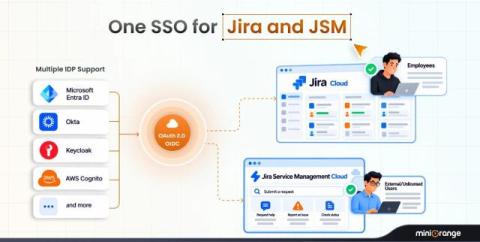
How miniOrange User Sync/SCIM Automates User Provisioning for Atlassian

Managing users in Atlassian manually, especially with large numbers of users, is time-consuming and error-prone. It’s inconvenient, but more importantly, it introduces major security risks in case an ex-employee still has access. Also, there’s no point in paying for extra licenses. miniOrange User Provisioning for Atlassian addresses this. It synchronizes users, groups, and directories directly from their identity providers into Jira and related Atlassian applications.

How to Collaborate with Vendors and Clients in Jira and Confluence Without Giving Full Access

Most teams using Jira and Confluence hit the same wall the moment external users get involved. You need clients and vendors to collaborate. But the platform forces a bad choice. Either give them full access and risk exposing internal data, or lock things down and slow everything to a crawl. Add to that the cost of licenses, and it becomes a structural problem, not just an operational one. The reality is simple. External users do not need your system.

From Small Town to Global Clients - Growth, AI & Cash Flow Lessons | Podcast with V Gautham Navada

V Gautham Navada, founder of ForthFocus, shares his entrepreneurial journey from freelancing in a small town to serving 350+ clients across 8+ countries. The discussion centered around "forthfocus" and its "10 Years of Vision, Innovation & Growth.

Enterprise Mobility Management: The Complete Guide to Securing Your Mobile Workforce

During and after the COVID-19 pandemic, workplaces are no longer confined to just office cubicles. With organizations adopting a Bring Your Own Device (BYOD) policy and employees using mobile devices for work, managing the security and productivity of a mobile workforce has become a critical business priority.

Drupal Risk-Based Access Control: Smarter Login Security for Modern Threats

A password alone isn't enough to ensure that there will be no unauthorized access to your systems. Someone could enter the correct credentials from another country, from an unknown device, at 3 AM, through a suspicious proxy network - and traditional login systems would still let them in. That’s the problem with static authentication. Modern Drupal websites, especially in healthcare and government sectors, need login security that can evaluate context, behavior, and risk before granting access.

SSO Access Governance: How Enterprises Control, Monitor & Secure Identity at Scale

One compromised login should never unlock an entire enterprise environment. Yet that is exactly the risk many organizations face when Single Sign-On is implemented without governance controls. While SSO simplifies authentication and improves user experience, it also concentrates access into a single identity layer that attackers actively target. That is why enterprises are investing in SSO access governance to bring structure, visibility, and accountability into identity management.

What Is the IAM Maturity Model? A Complete Guide

Most organizations do not fail IAM because they chose the wrong technology. They fail because identity controls evolve unevenly across the environment. MFA may protect workforce users but not contractors. Provisioning may be automated for SaaS applications while privileged accounts are still managed manually. Access reviews may exist on paper but lack enforcement, visibility, or accountability.

DPDPA Series Part 2: Security & Access Control (Live DPDP Webinar)

DPDP Act Stage 2 webinar moved beyond the fundamentals of India’s DPDP Act and focused on the practical side of implementation. The session explored the technical, operational, and governance layers organizations need to operationalize compliance at scale. Key highlights from the session: If you're leading privacy, security, compliance, or engineering initiatives, this session provides actionable guidance to help translate DPDP requirements into executable systems and processes.

SSO for AI Agents: The Identity Gap No One is Talking About

Single Sign-On (SSO) means fewer password headaches, faster access, and better security for human users. But the same cannot be said for AI agents. SSO, a core part of Identity and Access Management (IAM), which was initially built for humans, can no longer be used for AI agents. For humans, it was quite simple - just log in once, and authenticate across connected apps. However, when an AI agent tries to authenticate the same way, the traditional access model breaks fast.