Security | Threat Detection | Cyberattacks | DevSecOps | Compliance

AI Voice: I Tried to Make My Robot Hand Talk | AI Avenue Ep 1

In this episode you’ll go on a mission alongside Craig to find Yorick, his robot hand co-host, a voice. He’ll talk to experts at the NVidia GTC conference in San Jose, people on the street, and then travel to @elevenlabsio in London. You’ll learn how speech synthesis got its start and where it’s headed. You’ll hear about the challenges of making voices seem real, understand privacy concerns, and see the power voice gives us by augmenting our abilities.

Report: AI-Powered Phishing Fuels Ransomware Losses

AI-powered social engineering attacks are significantly more successful than traditional attacks, according to a new report from cyber risk management firm Resilience. The researchers state, “Social engineering attacks fueled 88% of material losses, with AI-powered phishing achieving a 54% success rate compared to just 12% for traditional attempts.” AI allows attackers to easily craft sophisticated phishing emails, as well as voice and video deepfakes.

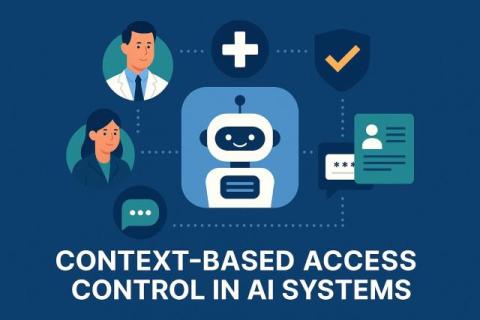
Why AI Security Breaks Without Context Based Access Control (CBAC)

Generative AI is transforming the way enterprises approach daily operations – powering virtual assistants, summarizing medical records, and aiding clinicians with insights. These benefits come at a cost: risk to a wide range of sensitive data in AI-driven workflows. Traditional access controls and content filters that work for static systems fail as these are not designed for the free-flowing, context-rich data exchanges in LLM applications.

Orchestrating AI: The practical way to scale while reducing tool sprawl

Every IT team is under pressure to “do more with AI.” A new tool promises smarter workflows, a new agent claims to replace manual tasks. But if you’re managing service requests, availability SLAs, patch cycles, infrastructure capacity, and application performance every day, you know the truth: AI doesn’t automatically reduce complexity on its own.

AI Safety Controls #cybersecurity #ai

Eric Capuano, founder of Digital Defense Institute, demoed permission controls using LimaCharlie's MCP server. When Claude recommended isolating compromised systems, Eric explained: "It's very aggressively recommending it's time to isolate these systems, but it is not authorized to fire off the isolate network command.".

Securing AI Workloads in Kubernetes: Why Traditional Network Security Isn't Enough

The AI revolution is here, and it’s running on Kubernetes. From fraud detection systems to generative AI platforms, AI-powered applications are no longer experimental projects; they’re mission-critical infrastructure. But with great power comes great responsibility, and for Kubernetes platform teams, that means rethinking security.

FBI Issues Guidance for Avoiding Deepfake Scams

The FBI and the American Bankers Association (ABA) have issued a joint advisory warning of the growing threat posed by AI-generated deepfake scams. “Criminals may pose as loved ones, government officials, law enforcement personnel, or even celebrities, often using fear and urgency to convince victims to send money or share sensitive information,” the advisory says.

What Is Data Privacy in AI? Explained Simply

If your company is shipping chatbots, copilots, or decision systems, you have probably heard the question many times: what is data privacy in AI, and how do we do it right. The answer is simpler than it looks. Data privacy in AI is a set of habits and controls that limit what personal or sensitive data you collect, how you use it, where you store it, and who can see it. When those habits are part of the build, AI products move faster, customers feel safer, and audits become routine.