

|
By Shankar Rajamani
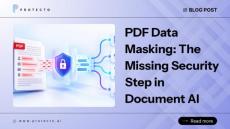
PDF data masking is the security step most document AI stacks skip. Most companies building RAG pipelines, agentic workflows, or document intelligence systems have secured the model, the vector store, and the API. They haven’t secured the step before any of that: the data inside the document itself, before it enters the pipeline. That gap shows up everywhere documents meet AI.

|
By Amar Kanagaraj
A Technical blog series on where sensitive data moves in an AI workflow, what decisions Protecto makes at each point, and what enterprises get from enforcing policy once instead of everywhere.

|
By Amar Kanagaraj
A Technical blog series on where sensitive data moves in an AI workflow, what decisions Protecto makes at each point, and what enterprises get from enforcing policy once instead of everywhere.

|
By Amar Kanagaraj
A Technical blog series on where sensitive data moves in an AI workflow, what decisions Protecto makes at each point, and what enterprises get from enforcing policy once instead of everywhere.
|
By Amar Kanagaraj
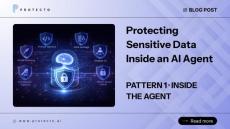
A Technical blog series on where sensitive data moves in an AI workflow, what decisions Protecto makes at each point, and what enterprises get from enforcing policy once instead of everywhere.
|
By Protecto
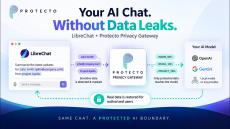
Self-hosting LibreChat gives you control over your chat infrastructure and conversation storage. But when you connect a hosted model such as OpenAI or Gemini, the prompts and context you send can still expose sensitive data. Protecto Privacy Gateway for AI Chat sits in that gap, in the request path between your LibreChat instance and whichever model you’ve connected.
|
By Amar Kanagaraj
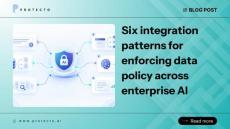
A Technical blog series on where sensitive data moves in an AI workflow, what decisions Protecto makes at each point, and what enterprises get from enforcing policy once instead of everywhere.

|
By Mariyam Jameela
Data sharing creates business value only when organizations can control where data goes, who can use it, and what happens after it leaves its original system. That becomes harder as businesses exchange customer records, financial information, healthcare data, and AI-ready datasets across employees, vendors, applications, and regions. The answer is not simply sending files through an encrypted channel.
|
By Mariyam Jameela
AI models rarely become a governance problem because of the model alone. The real risk often emerges from what surrounds it: the data it receives, the decisions it influences, the systems it can access, and the people accountable for its outcomes. That makes AI model governance a lifecycle discipline, not simply a model approval process. Even NIST’s AI Risk Management Framework treats governance as a function that cuts across the entire AI lifecycle.
|
By Mariyam Jameela
Protecting sensitive data is no longer just a compliance objective. It has become a prerequisite for adopting cloud services, enabling AI, and maintaining customer trust. Yet many organizations still struggle to balance innovation with effective data governance. A 2025 Forrester Total Economic Impact study commissioned by Microsoft found that organizations using mature data protection capabilities, including data loss prevention (DLP), achieved a 30% reduction in the likelihood of data breaches.

|
By Protecto
What if masking sensitive data actually broke your AI application? Most AI security strategies start with a simple rule: mask sensitive information before it reaches the LLM. But real AI workflows are more complex. An AI agent might need to search a CRM, retrieve a contract, check account details, call external tools, and generate a response. Each step may require a different level of access to sensitive data.
|
By Protecto
Can enterprises use powerful AI models with sensitive data without forcing everything into a self-hosted model? That's the problem this demo explores. In this session, we demonstrate Protecto Privacy Gateway integrated with LibreChat and show how sensitive enterprise data can be protected across AI chat, RAG, agents, MCP/tool calls, and long-running conversations.

|
By Protecto
Most DLP tools can mask a PII value on the way into a model. Almost none of them can make that value usable again when the AI needs to call a tool with it, so the masking breaks the workflow instead of protecting it. This is Protecto Privacy Gateway for AI Chat, live in a self-hosted LibreChat deployment. Watch what happens when a masked account number needs to resolve at a tool boundary — and comes back correct.

|
By Protecto
Sensitive data detection was much easier when information lived inside structured databases. Tables, columns, field names, and predictable data types gave security teams a clear map of where sensitive information lived. But when sensitive data moved into documents and PDFs, that map disappeared. Names, addresses, phone numbers, credit card numbers, and other sensitive information could be buried inside natural language.

|
By Protecto
Most healthcare AI systems rely on Retrieval-Augmented Generation (RAG) and vector databases to search millions of insurance claims, physician notes, lab reports, billing documents, and customer records. But what happens before those documents become searchable? In this Short, we explain how embedding models convert raw healthcare documents into vectors—and why patient names, medical record numbers (MRNs), diagnoses, and Social Security numbers can end up stored inside your vector database if data isn't protected before ingestion.

|
By Protecto
Why Your Healthcare RAG Pipeline Is Leaking PHI Most healthcare organizations believe their AI assistant is secure once they restrict who can log in. Unfortunately, that's only part of the story. Modern healthcare AI applications rely on Retrieval-Augmented Generation (RAG), where patient records, physician notes, insurance claims, and medical documents are embedded into vector databases to power intelligent search.

|
By Protecto
Planning an enterprise AI rollout in 90 days? Establishing a robust AI Gateway Architecture is the critical first step to ensuring data compliance, enforcement, and security. Letting application traffic run straight to LLMs exposes your organization to severe security and compliance liabilities.
|
By Protecto
Understanding the nuances of AI Traffic Security is critical because traditional firewalls and API gateways are fundamentally ill-equipped to inspect unstructured natural language. In the past, enterprise data remained safely within the corporate perimeter. Today, employees are pasting highly sensitive information directly into external models, creating a massive vulnerability where the risk lies in the meaning and content, rather than syntax or connections.

|
By Protecto
Sensitive data used to live in predictable places database columns, known field names, structured rows. That changed when data moved into documents. And it changed again when AI workflows arrived. In this video, we walk through why detecting sensitive data in AI pipelines is fundamentally different from traditional data discovery, and why the old approaches break. We cover the four failure modes that make detection hard in AI workflows.

|
By Protecto
AI agents don't just answer questions—they access enterprise data, call APIs, interact with MCP servers, and trigger workflows. That means sensitive information like PII, PHI, HR records, pricing data, financial information, and confidential business data can flow through AI systems. In this YouTube Short, Amar Kanagaraj explains why AI governance, data security, and data sovereignty are essential for enterprise AI deployments—and how the NetScaler × Protecto integration helps organizations secure AI workflows.

|
By Protecto
Know the challenges associated with managing data privacy and security, and the capabilities that organizations need to look for when exploring a data privacy and protection solution.

|
By Protecto
Improve your organization's privacy and security posture by automating data mapping. Read on to understand some best practices for privacy compliance.

|
By Protecto
Protecto can help improve your privacy and security posture by simplifying and automating your data minimization strategy. Read on to know more.
- October 2026 (3)
- September 2026 (8)
- August 2026 (8)
- July 2026 (16)
- June 2026 (11)
- May 2026 (8)
- April 2026 (16)
- March 2026 (22)
- February 2026 (8)
- January 2026 (12)
- December 2025 (15)
- November 2025 (19)
- October 2025 (23)
- September 2025 (13)
- August 2025 (12)
- July 2025 (4)
- June 2025 (6)
- May 2025 (2)
- February 2025 (10)
- January 2025 (15)
- December 2024 (8)
- November 2024 (10)
- October 2024 (15)
- September 2024 (13)
- August 2024 (10)
- July 2024 (10)
- June 2024 (13)
- May 2024 (10)
- April 2024 (5)
- March 2024 (13)
- February 2024 (21)
- January 2024 (4)
- December 2023 (1)
- November 2023 (1)
- September 2023 (3)
- August 2023 (3)
- June 2023 (1)
- May 2023 (2)
- March 2023 (1)
- January 2023 (1)
- October 2022 (1)
- December 2020 (1)
Easy-to-use API to protect your enterprise data across the AI lifecycle - training, tuning/RAG, response, and prompt.
Protecto makes all your interactions with GenAI safer. We protect your sensitive data, prevent privacy violations, and mitigate security risks. With Protecto, you can leverage the power of GenAI without sacrificing privacy or security. If you are looking for a way to make your GenAI interactions safer, then Protecto is the solution for you.
Data protection without sacrificing data utility:
- Achieve Compliance And Mitigate Privacy Risks: Preserve valuable information while meeting data retention regulations.
- Embrace Gen AI Without Privacy or Security Risks: Harness the power of Gen AI, ChatGPT, LLMs, and other publicly hosted AI models without compromising on privacy and security.
- Share Data Without Sacrificing Compliance: Comply with privacy regulations and data residency requirements while sharing data with global teams and partners.
- Ensure The Security Of Your Data In The Cloud: Protect your sensitive and personal data in the cloud. Gain control over your cloud data.
- Create Synthetic Data: Harness real-world data for testing without compromising on privacy or security.
- Achieve Data Retention Compliance with Anonymisation: Simplify compliance efforts and safeguard sensitive data.
Protect your enterprise data across the AI lifecycle.