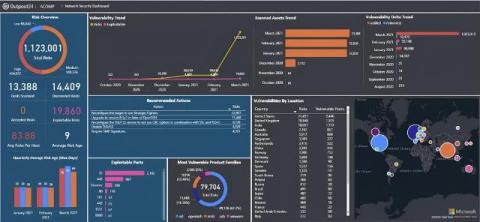
At its core, cyber risk quantification (CRQ) is a data-driven process that, in the end, offers security and risk managers an overview of their enterprise’s exposure to cyber risk.
We are thrilled to announce that the GitGuardian App has become the most installed application on GitHub's Marketplace. We are proud to have passed this milestone, with over 418K developers and organizations trusting GitGuardian to detect secrets in their shared repositories. GitGuardian is now protecting over 12.7M individual repositories. We have been the number one installed security application for some time, but now we have become the single most utilized app across all categories.
On March 7, amid media focus on the first-ever White House Crypto Summit, the U.S.’s primary national bank regulator, the Office of the Comptroller of the Currency (OCC), quietly issued an interpretive letter that could have significant implications for how national banks engage with digital assets.
Customer confidence is the fragile foundation of developing economies, and nowhere is this more true than Asia Pacific where phishing and customer account takeovers (ATO) threaten to bring that foundation crashing down. For financial institutions and airlines in APAC, scam-related fraud is no longer an isolated cost center—it is an existential risk to digital trust and economic growth.
The recently disclosed VMware ESXi vulnerabilities pose a serious security risk, enabling attackers to exploit virtualized environments through VM escape, remote code execution (RCE), privilege escalation, and data leakage. With cybercriminals actively targeting these flaws, organizations must act swiftly to secure their infrastructure.
Xona Systems, a leading provider of secure access management solutions for critical infrastructure, is partnered with Barrier Networks, a managed security service provider for industrial organisations, to deliver a comprehensive, fully managed secure access solution for critical OT environments. The partnership combines Xona’s cutting-edge secure access platform with Barrier’s deep operational cyber security expertise.
The robustness and reliability of an organization’s infrastructure are paramount in an evolving digital landscape. Effective infrastructure monitoring ensures seamless operations, preemptively identifies potential issues, and maintains optimal performance. As technology leaders, understanding and implementing comprehensive monitoring strategies is crucial to sustaining business continuity and achieving strategic objectives.
Organizations handling Controlled Unclassified Information (CUI) need to comply with NIST SP 800-171 Revision 3, a set of cybersecurity requirements developed by the National Institute of Standards and Technology (NIST). These guidelines apply to non-federal organizations, including private companies, defense contractors, and businesses in regulated industries, that process, store, or transmit CUI.
NIST Special Publication 800-53 revision 5 provides a comprehensive set of security and privacy controls to help organizations manage risk effectively. These controls are widely adopted by federal agencies and private organizations to enhance cybersecurity resilience. Compliance with NIST SP 800-53 r5 helps organizations strengthen their security posture, mitigate cyber threats, and ensure regulatory compliance.