Security | Threat Detection | Cyberattacks | DevSecOps | Compliance

Why most security training fails and how behavioral science can fix it

We need to face a bitter truth: Most security awareness training out there just doesn’t work the way it’s supposed to. Year after year, companies worldwide pour billions into all sorts of training programs, posters, and click-through modules, yet phishing click incident rates stubbornly persist with no sign of them fading away any time soon. So, what are we missing? According to Verizon’s Data Breach Investigations Report, the human element is involved in 62% of breaches.
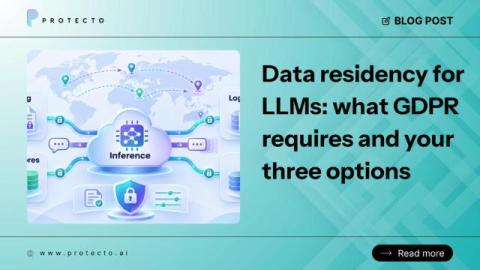

Data residency for LLMs: what GDPR requires and your three options

Short answer: GDPR does not require personal data to stay in the EU. It lets data leave only with a valid transfer mechanism. Data residency for LLMs comes down to three options: use the EU region of a hosted API, tokenize before the API call, or run the model yourself. Only the third keeps data out of the US in the literal sense. A procurement lead at a European customer sends your team a one-line requirement: “keine Daten in die USA.” No personal data in the United States.

bREACHYing the Perimeter: How One HTTP Request can Hijack your AI Robot

Software supply chain attacks are on the rise, and naturally taking the headlines. But with the rise of localized models and common software embedded into smart “things”, risks may even be hidden in plain sight – or, in some cases, quite literally watching you. Vulnerabilities and malicious packages may extend risks to the unlikeliest of places, demanding change and accountability in even some well-intended innovations.

17 Endpoints, Zero Logins Required: Broken Access Control in AI-Built Apps

We handed four vibe-coding tools (Emergent, Replit, Lovable, Base44) the same prompt for a FastAPI user-management microservice. The spec was explicit: JWT auth, parameterized queries, rate limiting, four-tier role model with per-endpoint scope. Each tool shipped a build, and our flagship autonomous pentest surfaced 137 confirmed vulnerabilities across all four.

Vibe Coding Security Checklist: Stress-Test Your AI-Built App in 10 Minutes

You shipped an app in a weekend. The AI wrote the login, the dashboard, and the database layer, and everything works, but it’s far from safe. With 0 logins, an attacker can forge admin invitations, alter audit logs, and change other users’ passwords. The guy is just swimming freestyle through your entire app stack. This is just one of the 137 vulnerabilities we found in vibe-coding across the top 4 platforms.

Warning: Phishing Operations Are Impersonating Prediction Markets

Fraudsters are exploiting the increased public interest in prediction markets such as PolyMarket and Kalshi, according to researchers at Recorded Future. Criminal groups known as “traffers” are providing fellow crooks with “websites, administrative panels, cryptocurrency payment infrastructure, victim-management capabilities, technical support, and promotional guidance” to target users of prediction markets.

CrowdStrike Secures AI Agents Inside Claude Cowork

When Claude Cowork executes code locally, it runs inside an isolated virtual machine on the user's computer. On the host, that VM runs as a single opaque process: The agent's activity inside the VM, including the processes it spawns, the packages it installs, and the network connections it makes, is not visible to the host's endpoint security sensor. Because host folders can be mounted into the VM, sensitive data can sit within the agent's reach.

Introducing AI Kill Switch: Taking Control When AI Agents Go Rogue

As organizations deploy increasingly autonomous and interconnected agents, the potential agentic blast radius grows. A single compromised or misaligned agent can trigger a chain of actions spanning credentials, applications, files, and enterprise systems that create consequences extending far beyond its original task. Traditional security approaches weren't designed to understand these behaviors, much less intervene at the speed agents operate. Security teams need more than alerts and investigations.