Security | Threat Detection | Cyberattacks | DevSecOps | Compliance

Claude Mythos Is Not the Problem. Your Security Basics Are

There is a lot of panic around Claude Mythos. Some people are saying it will hack every system, that the sky is falling, and that there is no stopping it. That fear is dangerous because it makes teams freeze. Claude Mythos is genuinely powerful. AI systems like this can find security issues in minutes that even experienced penetration testers might take weeks to identify and exploit. That part is real. But here is the important point: AI is still exploiting what is already there.

AI in security feels harder than it is

Anyone who's stood up a SIEM from scratch knows the feeling: weeks of infrastructure work, integration headaches, and a services team alongside for the whole process. That experience shaped how people think about adopting anything new in security ops. The instinct is to treat AI the same way: budget for it, plan for it, bring in specialists. This instinct is costing teams real time. Traditional infrastructure takes great effort to stand up. Infrastructure-as-code happens in seconds.

Designing AI workflows: principles for safety and control

Most teams adopting AI in their workflows understand that LLMs do not behave like traditional software. The same input does not always produce the same output, and even when it does, the model can be wrong, manipulated, or misled. Hallucinations happen even without adversarial input. Air Canada learned this in 2024 when a tribunal ordered the airline to honor a bereavement-fare refund policy its support chatbot had invented out of thin air.

Reviewing Malicious PRs at Scale with AI

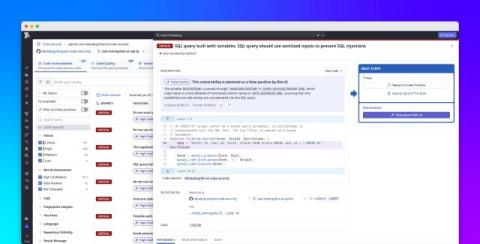
As AI coding assistants accelerate software development, the volume of pull requests at Datadog has grown to nearly 10,000 per week, increasing the risk that malicious changes slip through due to review fatigue. To address this, Datadog built BewAIre, an LLM-powered code review system designed to identify malicious source code changes introduced by threat actors. By reducing approval fatigue for developers while increasing friction for attackers, BewAIre guides human reviewers to the areas where judgment matters most, without slowing developer velocity.

The Top 12 Compliance Tools for Unapproved AI Use

Compliance teams have control over approved corporate systems like enterprise software, managed databases, and internal applications. But they don’t have the same over what employees paste into ChatGPT, upload to Claude, or share with Gemini and other unauthorized AI tools. As such, when auditors review AI usage controls, most organizations discover they can’t prove that employees aren’t exposing regulated data through external AI services.

CrowdStrike Launches Falcon OverWatch for Defender

CrowdStrike is excited to announce Falcon OverWatch for Defender, a new offering that extends our elite managed threat hunting to Microsoft Defender environments. The need for proactive threat hunting is increasingly urgent as adversary operations evolve: 82% of intrusions observed in 2025 were malware-free, the CrowdStrike 2026 Global Threat Report revealed, and the fastest eCrime breakout time was a mere 27 seconds. Adversaries using AI increased their attacks 89% year-over-year.

Introducing the New AI-Native KnowBe4 SAT

Cybercriminals are getting smarter and faster. Social engineering attacks are evolving rapidly, and AI is making them more convincing than ever. According to the 2025 Verizon Data Breach Investigations Report, up to 68% of cyberattacks involve some form of social engineering. Meanwhile, 95% of cybersecurity professionals say AI is making phishing attacks harder to detect, and 65% believe attackers will soon rely on AI as their primary tool. This isn’t just theory.

Announcing LimaCharlie Case Management: Built for agentic security workflows

Security operators often struggle with the escalating friction that naturally occurs in their detection and response (D&R) workflow. Detections fire in one tool. Investigations happen in another. Case tracking lives in a third. For MSSPs managing dozens of client environments, fragmentation compounds quickly. Analyst time bleeds into context-switching. SLAs are hard to track. When something goes wrong, reconstructing what happened across multiple platforms is painful.