Security | Threat Detection | Cyberattacks | DevSecOps | Compliance

Autonomous AI Accelerates Cyberattacks and Shrinks Response Time

The biggest challenge in cybersecurity is no longer just detecting threats. It's doing so before time runs out. Artificial intelligence is no longer confined to automating isolated tasks within an attack. It is enabling threats to operate as continuous systems that can adapt, coordinate, and evolve in real time, drastically reducing the time security teams have to react. This shift is doing more than simply increasing the volume of offensive activity.

ServiceNow, Then PeopleSoft: Why the Same Endpoint Failure Keeps Repeating

Three weeks ago, it was ServiceNow: an endpoint that never asked who was calling, exposing customer data to anyone who asked. This time it’s Oracle PeopleSoft, exploited at scale by the threat actor ShinyHunters. Two platforms, two different vendors, the same root failure: an endpoint that skipped the one question it existed to ask. That’s not a coincidence you write off as bad luck at two companies.

Gen. AI used to mislead victims in fraud campaigns

It is almost impossible to trust the source of an image or video anymore. On The Cybersecurity Defenders Podcast, Tamas Kadar, CEO and Co-Founder of SEON, explains how generative AI has reshaped what fraudsters can pull off. Setting up sophisticated fraud operations no longer requires coding skills, and synthetic identities and deepfake documents have become convincing enough that visual verification alone is no longer reliable.

Top 16 AI Agent Security Solutions

AI agent security solutions fall into two categories. Some use AI agents to perform security work, such as red teaming, pentesting, SOC investigation, threat hunting, and risk analysis. Others protect AI agents, copilots, MCP servers, and agentic workflows from vulnerabilities such as over-permissioning, prompt injection, unsafe tool use, data exposure, and unauthorized actions.

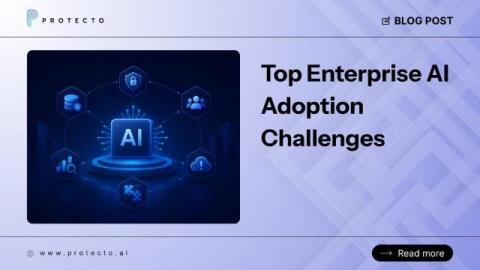
Top Enterprise AI Adoption Challenges

AI today has moved beyond experimentation. In the modern age, enterprises are embedding AI across various aspects of their businesses, including customer support, document processing, software development, healthcare, financial services, and decision-making workflows. According to a recent McKinsey report, 88% of businesses use AI in at least one business function. This reflects how AI is now becoming the center of several enterprise operations.

Shadow AI Is Not Shadow IT With a Better Marketing Budget

I saw a venn diagram on social media. One circle is Shadow IT, one circle is Shadow AI, a substantial overlap, and the implicit message is that they are effectively the same challenge. They aren’t and that the assumption can lead to many problems. Looking back, shadow IT was like watching a crash in slow-motion. Employees using technology IT hadn't sanctioned. Personal Dropbox accounts. Unofficial Slack workspaces.

DuneSlide: Two Critical RCE vulnerabilities via Zero-Click Prompt Injection in Cursor IDE

Cato AI Labs has discovered two critical remote code execution (RCE) vulnerabilities in Cursor IDE, the popular development environment which, according to Cursor, is used by over half of the Fortune 500. Both RCE vulnerabilities, which we refer to as “DuneSlide,” achieved a 9.8 CVSS score, and involve breaking out of the IDE’s sandbox environment and were assigned CVE IDs CVE-2026-50548 and CVE-2026-50549.

From ISDN to AI - Two Veterans on How Defence in Depth Has Changed

Defence in depth has evolved every time the technology landscape has shifted. The internet, virtualisation, cloud, SaaS. AI is the next shift, and the old model isn't keeping up. Welcome to Razorwire, the podcast where we share our take on the world of cybersecurity with direct, practical advice for professionals and business owners alike. I'm Jim and in this episode, I'm joined once again by Martin Voelk, co-founder of SpartanX and an ethical hacker with nearly 26 years in cybersecurity.

Embracing the Benefits of Smart Glasses Safely in the Workplace

We are witnessing a massive shift in how we secure corporate networks. Security operations centers used to be dedicated to protecting static desktop stations, local servers, and company-issued mobile hardware. However, today's spatial computing and edge-based AI have delivered a new, largely unregulated hardware threat directly into the corporate space - face-worn consumer hardware.

RAG vs Fine-Tuning: When to Use Each for Enterprise GenAI Applications

Let's suppose that your business is about to implement GenAI (generative AI). In this case, the conversation inevitably boils down to a dilemma: RAG (Retrieval-Augmented Generation) or Fine-Tuning. At first glance, these appear to be two competing methods for tackling the same problem-getting a base LLM (Large Language Model) to speak your company's language.