Security | Threat Detection | Cyberattacks | DevSecOps | Compliance

Help Safeguard Your SAP Environment with Splunk Security for SAP Solutions

Even though this blog discusses some serious topics related to security of mission-critical SAP applications, why not start it with a fun trivia question? So, here it is: “What does SAP stand for?” As per the company’s website, SAP is an acronym for the organization’s original German name “Systemanalyse Programmentwicklung,” which stands for System Analysis Program Development in English. Founded in 1972, SAP is a global leader in enterprise application software.

How to Secure Your Expanding (and Hidden) Cybersecurity Ecosystem

Your organization’s cybersecurity ecosystem is complex. It covers a wide range of internal digital assets but also extends beyond the network perimeter to other entities, such as vendors, suppliers, and cloud service providers—making you increasingly vulnerable to cyber risk. To secure this ecosystem, you need both an outside-in and inside-out perspective of vulnerabilities and risks.

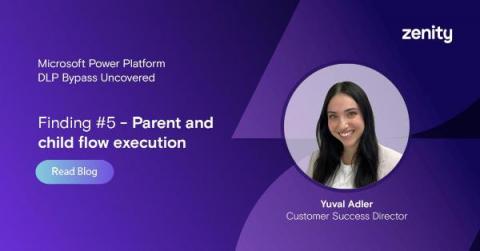
Microsoft Power Platform DLP Bypass Uncovered - Finding #5 - Parent and Child Flow Execution

Analysis of Microsoft Power Platform’s security features revealed limitations that could expose organizations to security risks, such as difficulty enforcing DLP policies for pre-existing resources and issues with HTTP calls or custom connectors.

Encrypting files and emails: A beginner's guide to securing sensitive information

The content of this post is solely the responsibility of the author. AT&T does not adopt or endorse any of the views, positions, or information provided by the author in this article. In today's digital age, sensitive information is constantly being shared and transmitted over various electronic devices and networks.

What Is Security Automation?

Security automation refers to the process of automatic detection, inspecting, and remediation of cyber threats. This can be done with or without the aid of humans by using specific applications built for the purpose. This minimally human-assisted process is used for integrating security flows, applications, and organizational infrastructure. This Blog Includes show Why Is IT Security Automation Important?

Why is the US DoD taking a Zero Trust Approach?

Recently the US Department of Defense (DoD) cyber-perimeter had been breached by state-sponsored and individual hackers. Vulnerabilities exposed by data breaches inside and outside the DoD demonstrate the need for a more robust cybersecurity framework that facilitates risk-based protection. In October 2022, it released the “DoD Zero Trust Strategy” and road map.

Snyk and ServiceNow collaborate on new SBOM solution

ServiceNow’s biggest event of the year — Knowledge 2023 — is here, and Snyk is excited to be a part of it with some big news! Back in January, we announced Snyk Security for Application Vulnerability Response to bring Snyk Open Source software composition analysis to ServiceNow Security Operations.

API5:2019 Broken Function Level Authorization: The What, Impact, Sample Exploit, and Prevention Methods

APIs are great for accessing specific functions and features, but what happens when they allow unauthorized access? Imagine a social media platform where users can share posts. To enable users to access posts, the platform provides an API that allows GET requests to retrieve posts by specifying the user ID and post ID. GET/api/v2.1/user/1438/posts?id=40. The API will return the 40th post for user id 1438. As these are public forums, any user can submit GET requests to access posts.

Millions of Toyota Owners Have Their Locations Exposed for the Last 10 Years

Toyota is a worldwide car manufacturer based in Toyota City, Japan. This automaker produces millions of vehicles each year, and many of those vehicles had their locations publicly available for as long as ten years. If you drive a Toyota vehicle, your location may have been available to anyone interested in seeing it, all because of a cloud configuration mistake. This mistake compromised the privacy of over 2 million Toyota car owners and is a serious hit to Toyota's name and reputation.

Updated Cato DLP Engine Brings Customization, Sensitivity Labels, and More

Last year, we launched Cato DLP to great success. It was the first DLP engine that could protect data across all enterprise applications without the need for complex, cumbersome DLP rules. Since then, we have been improving the DLP engine and adding key capabilities, including user-defined data types for increased control and integration with Microsoft Information Protection (MIP) to immediately apply sensitivity labels to your DLP policy. Let’s take a closer look.