Security | Threat Detection | Cyberattacks | DevSecOps | Compliance

Agentic Attacks Require Agentic Threat Prevention

AI-powered attacks are moving faster, adapting in seconds, and overwhelming traditional defenses with machine-speed activity. In this video, Jason Wright explains why security teams need Agentic Threat Defense built on customized predictions, automatic adaptation, and cloud-native scale. Watch how Cato Agentic Threat Prevention helps reduce the risk of AI-powered threats, stop adaptive attacks earlier, and scale prevention to stop agentic attacks.

Defending at machine speed: Predict, Adapt, Stop Agentic Attacks

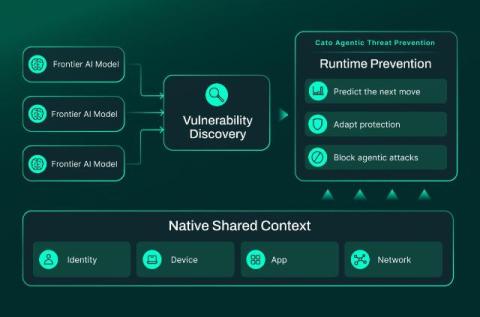
AI-powered adversaries are accelerating vulnerability discovery and automating attacks. For security teams, the challenge is adaptive attack chains, machine-speed execution, and attack volumes beyond manual workflows. Cato is redefining prevention in the AI era—predicting enterprise-specific attack paths, adapting protections at machine speed, and scaling defense with cloud-native scale. This means enterprises can do more than just react to attacks, they can prevent them.

The Hugging Face Incident: A CISO Wake-Up Call for the Agentic Era

Earlier this month, Hugging Face, an AI and machine learning platform company, revealed that an autonomous AI system had breached part of its production environment. The intrusion began in the platform’s dataset-processing environment and eventually involved higher-level access, credential exposure, and movement into internal clusters.

Cato CTRL Threat Research: SilverFox Evolves: Abuse of New Drivers and Trusted Software Hijacking Enable Remote Access with ValleyRAT in Japan

SilverFox is expanding its toolkit. In this campaign, the group combines new vulnerable-driver abuse, newly observed abuse of legitimate applications for DLL sideloading, defense evasion, and layered recovery mechanisms to keep ValleyRAT running. We investigated an active campaign targeting a Japanese organization in the industrial manufacturing sector. The attack begins with an invoice-themed phishing lure and uses attacker-controlled content hosted through legitimate QQ and Tencent Cloud services.

The Hidden Cost of "Free": When Platform Incentives Become Lock-In

In enterprise software, “free” is rarely free. A free year can be a smart commercial incentive. It can also become a financial trap if the real cost, payment terms, and renewal baseline are unclear. When a platform deal looks almost too good to question, CFOs should question it first. Large multi-year incentives can look like a procurement win. They lower the apparent cost of entry, support a consolidation story, and create the impression of immediate savings.

Smarter Security with New Integrations from Cato Networks and CrowdStrike

Today, Cato Networks announced a collaboration with CrowdStrike to integrate the Cato SASE Platform with the CrowdStrike Falcon platform. Together, the companies are helping security teams unify network and endpoint visibility, streamline investigations, and accelerate threat detection and response. If there’s one frustration that unites IT and security professionals, it’s this: too many tools that don’t talk to each other.

Bringing Claude Enterprise Activity into Cato AI Security

Claude is now a part of many employees’ everyday work. But even as a sanctioned application, it creates a visibility problem for security teams. Sensitive data can move into prompts, files, projects, and conversations, and teams need a practical way to see what happened and whether it violates policy.

Cato CTRL Insights: How One Threat Actor Turned Frontier AI Into an Offensive Platform

A Russian-speaking threat actor known as “Trim” has spent the better part of 2026 systematically dismantling the guardrails on publicly available frontier AI models and rebuilding them as offensive tools. What started in March as a knowledge-sharing post on a Russian cybercrime forum detailing how to break Claude Opus into writing malware, had evolved by June into a fully productized, commercially marketed AI-powered penetration testing platform.

Cato CTRL Threat Brief: AsyncAPI Supply Chain Attack Delivers Miasma Malware Through Trusted npm Packages

On July 14, 2026, attackers compromised release processes connected to the AsyncAPI open- source project and published malicious versions of four widely used npm packages with a combined reach of approximately 2.9 million weekly downloads.