Security | Threat Detection | Cyberattacks | DevSecOps | Compliance

Top 9 Netwrix Auditor reports for NIS2 compliance audits

NIS2 changes what "good enough" security looks like for a huge slice of the European economy. If your organization operates in energy, transport, finance, health, digital infrastructure, or any of the other sectors the directive designates as critical infrastructure, you can no longer choose whether to formalize your cybersecurity risk management. Instead, you have to decide how fast you can prove it.

How to Mark and Label CUI Correctly for CMMC

CMMC is vast and complex, but when you drill down to the heart of it, it's all about one thing: properly securing CUI. And yet that, in and of itself, is a problem. All CUI needs to be marked, which means if you receive CUI from your agency or prime, it needs to be properly marked. And it means if you produce CUI, you need to mark it properly yourself. How do you know what is and isn't CUI, and how do you mark it properly? What happens if you get it wrong?

Stopping Data Exfiltration From Departing Employees

Departing employees still email files to personal accounts and copy them to USB drives. Now they also paste sensitive content into ChatGPT, Claude, or Gemini to summarize a codebase, draft a portfolio piece, or package a project before their last day. Neither channel has replaced the other. The attack surface has simply gotten wider, and most security teams are still staffed and tooled for the channels they already know how to watch.

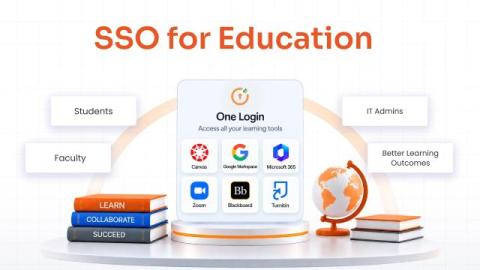
SSO for Education: Secure and Simplify Access to Learning Applications

Students, teachers, and faculty now move across a growing stack of learning, collaboration, communication, and administrative applications. Every new platform can mean another login to remember and another account for IT teams to manage. That creates friction for users and a growing access-management burden for institutions. SSO for education brings these applications behind a central authentication layer, allowing users to access authorized services with one institutional identity.

Cloud Infrastructure Entitlement Management (CIEM): A Complete Guide

In the cloud, an identity is no longer necessarily a person. It can be an application calling an API, a workload accessing storage, a service account running an automated process, or a machine interacting with another cloud resource. Each needs permissions to operate, and each becomes part of an access environment that changes as quickly as the infrastructure itself. This has expanded identity security beyond managing users and accounts to governing a much larger ecosystem of human and non-human access.

The Cyber Loss That Fits Inside a Single Weekend

An annual exposure figure for a retailer treats the year as uniform. Divide expected loss across twelve months, apply a duration, produce a number. The instinct that this understates a peak-season outage is correct and the usual reason given for it is wrong. ‍ The concentration is not where people assume, and the mechanism that makes a December outage expensive is not volume. It is that the demand has a deadline. ‍

The AI Agent Whose Builder Already Left

Somebody in operations builds an automation inside a sanctioned platform to solve a problem in their own workflow. It works, other people come to depend on its output, and eighteen months later that person leaves. ‍ The platform still lists the automation. Nobody inherits it, because it was never anybody's asset to begin with, and the offboarding checklist has no line for a thing that was never recorded as belonging to the person departing. ‍

No Link to Click: How a Text and a Phone Call Defeated MFA

No link was clicked. No malware was installed. No email gateway was crossed. A software development director lost her account in under two minutes. This is the full chain, in real time: a text message that offers to prevent a problem rather than asking for anything, a phone number she dials herself, a calm voice that explains what she is about to see before she sees it, and six digits read out loud.