Security | Threat Detection | Cyberattacks | DevSecOps | Compliance

Recognizing and detecting data exfiltration

Every breach that lands a CISO in front of the board has a common final act: Data leaving the building. Attackers don't get paid for breaking in. They get paid for what they take out. And by the time stolen data appears on an extortion site or in a regulator's inbox, the window to stop the damage has already closed. That is what makes exfiltration so dangerous. It rarely looks like an emergency.

OT: The Other Technology Evolution

Written by Bill Moore, CEO & Founder TL;DR In Part 1 of this series, I looked at how computing and telecommunications gradually became what we now call Enterprise IT. That change did not happen because someone decided to merge two departments. It happened because the technologies, the systems, and the work they supported became too interconnected to describe separately.

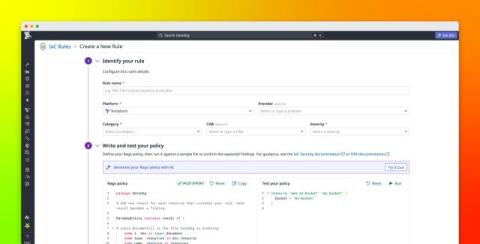
Enforce custom rules in Datadog IaC Security scanning

Infrastructure-as-code (IaC) security scanning can catch common misconfigurations before deployment, but every organization also has internal requirements that a default rule catalog cannot cover. For example, teams may need to enforce required tags, approved instance types, or naming conventions. With custom rules for Datadog IaC Security, security and platform teams can define these requirements as Rego policies and run them alongside Datadog’s default rules during IaC scans.

Cineworld Glitch Purportedly Allows Users To See Member Card Details

On 17 September 2026, users on X (formerly Twitter) posted that payment details belonging to other individuals had appeared on the Cineworld app under their personal accounts. On 17 September 2026, users on X (formerly Twitter) posted that payment details belonging to other individuals had appeared on the Cineworld app under their personal accounts.

CVE-2026-67401: SQL Injection in cPanel's EmailTrack Puts Shared Hosting Environments at Risk

A critical SQL injection vulnerability has been identified in cPanel & WHM’s EmailTrack functionality. The vulnerability was disclosed by cPanel on September 8, 2026, affecting every supported release line. It allows an authenticated cPanel account holder with mail related privileges to ultimately achieve root-level code execution on the underlying host.

What is SLH-DSA? Hash-Based Post-Quantum Digital Signature Guide

SLH-DSA is NIST’s standardised post-quantum digital signature algorithm (hash-based). It generates quantum-resistant signatures, ensuring signatures are not changeable and that they will not be forged, even when later superseded by schemes like RSA and ECDSA, which are susceptible to attacks by quantum computers. Organisations are studying it today because large-scale quantum computers could, in the future, crack the algorithms that currently underpin most digital trust.

How Public VIN Records Become Part of Your Digital Footprint

When people think about online privacy, they usually consider email addresses, phone numbers, social media accounts, or browsing activity. Vehicle information rarely comes to mind. Yet a car can develop its own extensive digital footprint. A Vehicle Identification Number may connect publicly accessible auction listings, photographs, mileage readings, damage descriptions, specifications, and sale information that remain searchable long after the original event.

Agentic AI for ITOps: Is your organization ready for the security challenges?

AI is set to provide increasing value in IT by enabling more ways to simplify complex IT operations, offering actionable insights, automating routine tasks with context-aware automation, and detecting abnormal events with advanced machine learning algorithms. With agentic AI, systems can understand what is happening in an IT environment, reason about the most probable root causes, determine the right course of action, and implement these changes without requiring additional human intervention.

The answer to AI uncertainty is adaptability, not paralysis

AI uncertainty is not a strategic reason to wait; it is a strategic imperative to build adaptable organizations that can innovate confidently, govern risk proportionately, and respond effectively as technology and threats evolve. Every few weeks, the AI conversation seems to reset around a new warning. A model demonstrates an unexpected capability. An autonomous agent behaves in a way its designers did not anticipate. A new forecast describes how quickly AI could transform work, security or society.