GitHub: Hackers Breached Multiple Orgs Using Stolen OAuth User Tokens
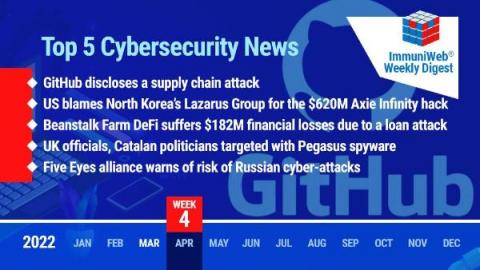
Read also: the US blames North Korea’s Lazarus Group for the $620M Axie Infinity hack, Beanstalk Farm suffers $182 million financial losses due to a cyber-attack, and more.


Read also: the US blames North Korea’s Lazarus Group for the $620M Axie Infinity hack, Beanstalk Farm suffers $182 million financial losses due to a cyber-attack, and more.
Today’s threat landscape is evolving rapidly. Attackers are constantly adjusting their tactics and finding new ways to infiltrate organizations with increasingly sophisticated attacks to steal valuable data. As such, businesses and IT professionals must remain up to date on the industry’s latest threat intelligence in order to better understand the current state of this cybersecurity landscape and know their enemies to shore up defenses.
As mentioned in SecurityScorecard’s (SSC) previous Zhadnost blog posts (part one and part two), the DDoS attacks against Ukrainian and Finnish websites do not appear to have a lasting impact, as the sites were back online within hours of the attack.
Telecommunication is the first, and most robust network ever invented. This may seem like a brazen and bold statement, but when examined closely, it is not the stuff of fantasy. Prior to the invention and development of the internet, what other way could a person pick up a device, and “dial” a few numbers and end up seamlessly connected to someone across the vast expanse of a countryside?
We've recently been inundated with news of increased cyberattacks and a general increase in cyber threats online. Hackers - both bad and good, government related or private groups - have their hands full every day as never before and compounding the situation is the Russia-Ukraine (UA) war which has sparked a cyber storm. This made us just more curious about Internet attacks on the UA telecom infrastructure.
A democratized approach to cybersecurity risk management that leverages continuous monitoring and public-private partnerships is overdue, and critical, for today’s cyber threat environment.