The modern infrastructure is controlled by the DNS with pointers to both internal and third-party services. As a result, organizations are simultaneously expanding their attack surface and inviting potential cyber threats. Unknown subdomains can be challenging, as they are not always closely monitored.
Financially motivated adversary groups executing ransomware attacks have rightfully gotten our attention in recent years. Similar to Lulzec, there’s a new group catching attention with different motivations, targeting larger organizations.
Economic Denial of Sustainability (EDoS) is a cybersecurity threat targeting cloud environments. EDoS attacks exploit the elasticity of clouds, particularly auto-scaling capabilities, to inflate the billing of a cloud user until the account reaches bankruptcy or large-scale service withdrawal. EDoS attacks exploit the cloud’s economies of scale to disrupt or discontinue the availability of cloud services and infrastructure that support applications, systems, and corporate networks.
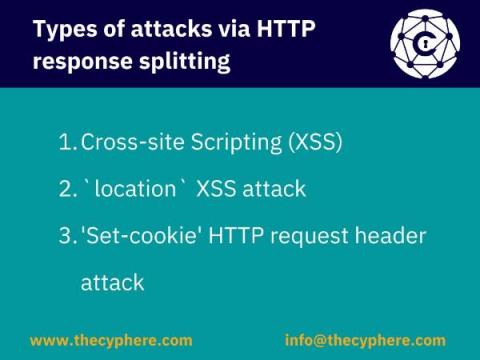
HTTP Response Splitting entails a kind of attack in which an attacker can fiddle with response headers that will be interpreted by the client. The attack is simple: an attacker passes malicious data to a vulnerable application, and the application includes the malicious data in the single HTTP response, thus leading a way to set arbitrary headers and embedding data according to the whims and wishes of the attacker.
Given Russia's reputation for highly-sophisticated cyberattacks, the country's invasion of Ukraine has sparked justified fears of an imminent global cyberwar. While, for the time being, Putin’s cyber efforts against Ukraine are surprisingly restrained, this may not be the case for other countries.
Endpoint devices played a big part in malware and ransomware attacks in 2021. According to a study covered by Help Net Security, security researchers detected more malware and ransomware endpoint infections in the first nine months of the year than they did for all of 2020. Attack scripts leveraging PowerSploit, Cobalt Strike, and other tools were particularly prevalent in that nine-month period, having grown 10% over the previous year after having already climbed 666% compared to 2019.
The ongoing war between Ukraine and Russia has placed organizations worldwide on full alert due to the possibility that cyber attacks related to the conflict may impact organizations outside the region.