Security | Threat Detection | Cyberattacks | DevSecOps | Compliance

A Strategic Framework for Third-Party App Risk Management

Third-party code now accounts for 66% of the most dangerous, long-lived vulnerabilities across application portfolios, according to Veracode’s 2026 State of Software Security Report. For AppSec and engineering leaders, that stat tells a familiar story: shrinking release cycles, expanding open-source dependency footprints, and mounting regulatory pressure.

AI Agent Security: The Hidden Threat Your Firewall Can't Stop

If your AI security strategy is focused on stopping copy-pastes into chatbots, you're fighting yesterday's war. AI agent security is now the real endpoint challenge — autonomous agents operating with your users' credentials. Traditional firewalls, CASBs, and DLP weren't built for agentic AI. They can't see delegated credentials, multi-step tool calls, or live runtime execution across IDEs, browsers, and local apps.

Copy, Paste, Compromised: How ClickFix Attacks Work and How CrowdStrike Stops Them

Consider this hypothetical scenario: An employee tries to join what looks like a routine video meeting. The page loads, but instead of the meeting, they see an error message along with a helpful fix: Copy the provided command, open the Windows Run dialog, paste it, and press Enter. The meeting never starts. The command does something else entirely. This is ClickFix, a social engineering technique that turns the victim into the mechanism for executing an attack.

What Is VMware vSphere Proactive HA? | Proactive Host Monitoring Explained

What Is VMware vSphere Proactive HA? What if you could identify potential VMware host hardware issues before they lead to a failure? vSphere Proactive HA helps improve availability by monitoring the health of ESXi hosts and taking action when potential hardware problems are detected. In this video, learn: What VMware vSphere Proactive HA is How Proactive HA monitors host health How it helps prevent workloads from running on unhealthy hosts How Proactive HA works with VMware DRS The difference between proactive host management and traditional High Availability.

Critical Citrix NetScaler ADC and Citrix NetScaler Gateway Vulnerabilities

On September 27th 2026, Citrix disclosed multiple vulnerabilities affecting NetScaler ADC and NetScaler Gateway. Arctic Wolf tracking indicates that CVE-2026-88771 and CVE-2026-88772 have been exploited in attacks against NetScaler devices as zero-days. Additional CVEs are also disclosed in the Citrix Security Bulletin. CVE-2026-88771 is an unauthenticated remote code execution vulnerability caused by improper input validation that can allow arbitrary command execution.

Gen's Curtis Koenig on treating AI agents like human users to prevent security failures

Your backlog of low and medium severity vulnerabilities just became a real threat. AI can now chain them into critical exploits, and the window between exploit discovery and active use is around eight hours. Curtis Koenig, Head of Application Security at Gen, joins the show to explain why treating AI agents like human users is the single most important step security teams can take this year. CHAPTERS.

Cybersecurity ROI Calculator: Measure Your Investment

Security teams have always had to justify their budgets, and the bar for that justification keeps rising. Boards and CFOs want proof that security spending delivers measurable business value: reduced risk translated into financial language. That pressure has made cybersecurity ROI calculators a standard part of the security leader’s toolkit, a way to convert threat prevention, automation efficiency, and incident response improvements into the numbers executives understand.

From Isolated Attacks to Continuously Optimized Operations

Security teams have spent years improving their ability to detect and respond to cyber threats. More visibility, better tools, and richer telemetry have helped organizations identify suspicious activity across users, devices, applications, and infrastructure. But the nature of the challenge is changing. Modern attacks are rarely defined by a single event.

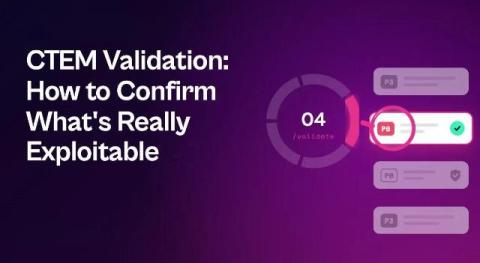
CTEM Validation: How to Confirm What's Really Exploitable

CTEM validation is the fourth stage of continuous threat exposure management. It confirms whether a prioritized exposure is actually exploitable in your environment and whether existing defenses would stop an attack. Common methods include penetration testing, breach and attack simulation, attack path analysis, and automated exploitability analysis.