
Security | Threat Detection | Cyberattacks | DevSecOps | Compliance

Cloudflare deploys protections against php2shell vulnerability

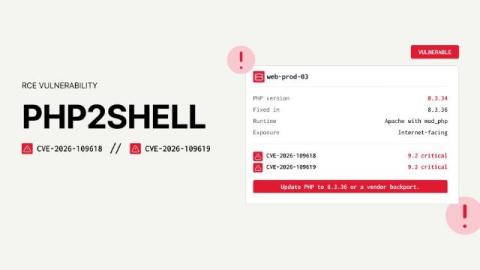
Today, Calif.io, Wiz, OpenAI and Quarkslab disclosed two vulnerabilities in PHP, tracked as CVE-2026-109618 and CVE-2026-109619 and known as php2shell. The vulnerabilities affect all web servers running PHP 5.4 or later and they may allow an attacker to cause denial of service, remote code execution, and data exposure when an application processes specially crafted HTTP traffic.
Proof-of-concept exploit released for PHP vulnerabilities (CVE-2026-109618, CVE-2026-109619)

In response to requests, this update consolidates the Sophos countermeasures that relate the PHP2Shelll vulnerabilities. SophosLabs has developed the following countermeasures to specifically detect activity associated with this threat. The next table lists additional pre-existing Sophos countermeasures that will likely address post-exploitation activity associated with these vulnerabilities.

CrowdStrike Protects Customers from Threats Delivered via PHP2Shell

Two critical memory-corruption remote code execution (RCE) vulnerabilities, collectively dubbed PHP2Shell, have been disclosed in core PHP, the underlying engine powering a vast portion of the web. The CrowdStrike Falcon platform provides out-of-the-box visibility and detection coverage for post-exploitation activities of both vulnerabilities.

PHP2Shell: Responding to CVE-2026-109618 and CVE-2026-109619

If you run PHP anywhere in your environment, patch to PHP 8.5.12, 8.4.27, 8.3.36 or 8.2.35 now. Two critical flaws disclosed this week, CVE-2026-109618 and CVE-2026-109619 (nicknamed "PHP2Shell"), let an unauthenticated attacker run code on a server with nothing more than a crafted web request. Both carry a CVSS v4.0 score of 9.2, every earlier release is affected, and exploitation in the wild has been reported. The patch is the easy part.

CVE-2026-109618 and CVE-2026-109619 (PHP2Shell): Two Critical PHP Remote Code Execution Flaws

The PHP security team has announced an emergency security release for Wednesday, October 21, 2026 at 14:00 UTC. It addresses two critical vulnerabilities, both rated CVSS v4.0 9.2. The vulnerabilities are tracked as CVE-2026-109618 and CVE-2026-109619. Both bugs are described as remote code execution issues, meaning an attacker could get their own commands running on a vulnerable server. The route to disclosure was messy.

How to Manage Debugging and Customisation in Encoded PHP Applications

Encoding PHP is not just a security decision, it’s a deployment decision. It affects how your application is maintained, debugged, and extended over time. It’s important to consider how the needs of your users may change after you deploy your application – sometimes that includes the need for fixes or small adjustments. Managing what you encode with ionCube When PHP files are encoded the original source code is completely removed from files.

ionCube Loader - Running existing encoded files on future PHP versions

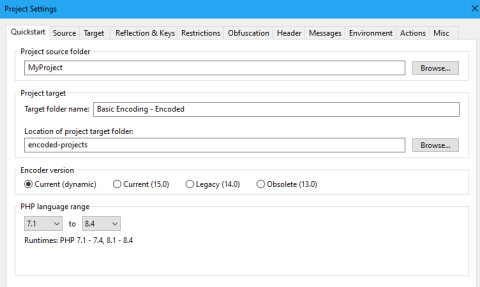
ionCube Loader is the runtime partner to ionCube Encoder which actually runs your encoded files on deployment machines. One useful feature of the Loader is that it includes runtime compatibility support which allows existing encoded files to run on future PHP versions where technically possible. This capability helps software vendors adopt newer PHP releases with greater flexibility as they won’t always need to re-encode and redistribute code in order to support new PHP versions.

Laravel APP_KEY Leaks Lead to RCE: GitGuardian + Synacktiv Reveal Massive Threat

In this video, cybersecurity researcher Guillaume Valadon of GitGuardian breaks down how exposed Laravel APP_KEYs on GitHub can lead to full Remote Code Execution (RCE) in real-world applications. Working in collaboration with Synacktiv, the team uncovered 260,000 exposed keys, validated 600+ vulnerable apps, and revealed that over 35% of leaks also exposed critical credentials like database passwords, cloud storage tokens, and API keys.

User Logins for in-house PHP Apps and Sites with Connectors

miniOrange connectors improve your PHP apps' and sites’ security by implementing SSO, MFA, and user synchronization. With a wide range of protocol support like SAML, LDAP, and OAuth, miniOrange connectors will improve your security, effectiveness, and efficiency in your workflow. Securing PHP applications and websites is made easier with miniOrange connectors. Timestamps: miniOrange, a trusted name in identity and access management, empowers organizations worldwide with robust, scalable, and secure solutions.

Understanding CVE-2024-50340 - Remote Access to Symfony Profiler

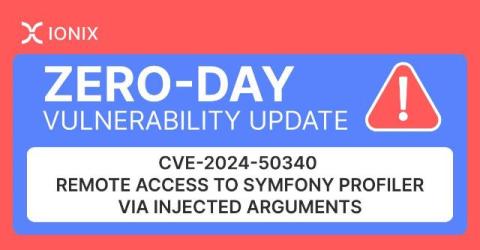
According to security researcher nol_tech CVE-2024–50340 is a critical vulnerability (CVSS: 7.3) affecting Symfony applications when the PHP directive register_argc_argv is enabled. By appending ?+--env=dev to a URL, attackers can force the application into the dev environment, granting remote access to the Symfony profiler. This exposure can lead to the leaking of sensitive information and potentially executing arbitrary code.