Security | Threat Detection | Cyberattacks | DevSecOps | Compliance

BERT Embeddings: A Modern Machine-learning Approach for Detecting Malware from Command Lines (Part 2 of 2)

CrowdStrike data science researchers recently explored and experimented with the use of Bidirectional Encoder Representation from Transformers (BERT) for embedding command lines, focusing on anomaly detection, but without detailing the model itself. Diving deeper into that research, CrowdStrike researchers explain the reasons for using BERT for command line representation and how to train the model and assess its performance.

Elastic Protects Against Ransomware and Linux Threats in MITRE Engenuity Round 4 Eval

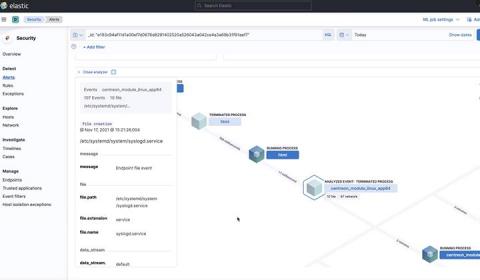
That’s right all, it’s time for the latest MITRE Engenuity ATT&CK® evaluation. As we have come to expect each year, Elastic — along with other security vendors — are evaluated by MITRE Engenuity, a tech foundation that brings MITRE research to the public. The evaluation focuses on emulating techniques from the MITRE ATT&CK (Adversarial Tactics, Techniques, and Common Knowledge) framework to assess vendor protection capabilities.

Threat Update: CaddyWiper

As the conflict in Eastern Europe continues, the Splunk Threat Research Team (STRT) is constantly monitoring new developments, especially those related to destructive software. As we have showcased in previous releases in relation to destructive software and HermeticWiper, malicious actors modify their TTPs in order to become more effective and achieve their objectives.

An Analysis of Ransomware Encryption Speeds by Splunk SURGe

Did you know the median time for ransomware to encrypt nearly 100,000 files is 42 minutes and 52 seconds? This speed is likely beyond the capabilities of most organizations to respond effectively before encryption is complete. These findings are the result of research published by SURGe, Splunk’s strategic cybersecurity research team.

Cyber Compliance and Data Breach Notifications

Ransomware isn’t just an internal threat for your organization, it’s also a global crime, and data breach notifications are governed by various laws, policies, and agencies. Let’s go over some common cyber-compliance questions about ransomware, data breach notification and reporting, and the laws that cover cybercrime.

Threat Update DoubleZero Destructor

The Splunk Threat Research Team is actively monitoring the emergence of new threats in the cyber domain of ongoing geopolitical events. As we have shown previously in several releases, including HermeticWiper and CaddyWiper, actors in this campaign are deploying, updating, and modifying stealthier malicious payloads. On March 17th, 2022, the Ukraine CERT discovered a new malicious payload named DoubleZero Destructor (CERT-UA #4243).

Vidar Malware Launcher Concealed in Help File

Appending a malicious file to an unsuspecting file format is one of the tricks our adversaries use to evade detection. Recently, we came across an interesting email campaign employing this technique to deliver the info stealer Vidar malware. First, let’s examine the email delivery mechanism, then go on to take a closer look at the Vidar malware itself. Figure 1: The malicious spam message The messages in this campaign have two things in common.

Outpost24 webinar - The State of Ransomware in 2021 and How to Limit Your Exposure

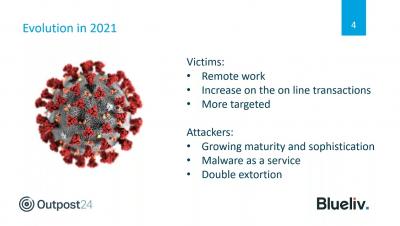
Ransomware has continued to grow in maturity throughout the first half of 2021. As businesses struggle to understand yet another major attack that hit the Kaseya supply chain, organizations are beginning to realize data backups and cyber insurance alone won’t save them.

AvosLocker ransomware - what you need to know

AvosLocker is a ransomware-as-a-service (RaaS) gang that first appeared in mid-2021. It has since become notorious for its attacks targeting critical infrastructure in the United States, including the sectors of financial services, critical manufacturing, and government facilities. In March 2022, the FBI and US Treasury Department issued a warning about the attacks.