Security | Threat Detection | Cyberattacks | DevSecOps | Compliance

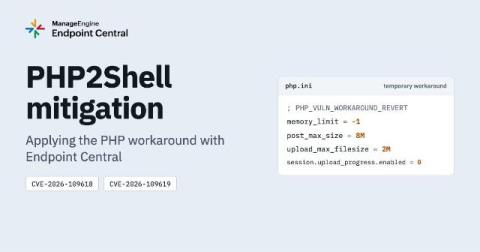
PHP2Shell mitigation: Applying the PHP workaround with Endpoint Central

On October 21, 2026, PHP fixed two critical unauthenticated remote code execution flaws, CVE-2026-109618 and CVE-2026-109619. CISA added both to its Known Exploited Vulnerabilities catalog on October 26th. The real fix is upgrading PHP and restarting every worker process. But many Windows servers can’t do that yet: the vendor hasn’t certified the new version, the PHP branch is end-of-life, or nobody knows whether a PHP copy exists inside an old application.
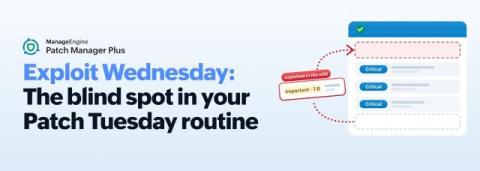

Exploit Wednesday: The blind spot in your Patch Tuesday routine

On Patch Tuesday in January 2023, Microsoft fixed a privilege escalation flaw in afd.sys, the Windows driver behind the Winsock networking interface. Two IBM X-Force researchers who had never worked with that driver compared the old and new versions of the file and had a working exploit for Windows 11 in about a day. China's 360 IceSword Lab later reported finding the same flaw already exploited in the wild that month.

Sophos Helps Organizations Secure the AI-Era Network as Demands on Performance and Protection Grow

New innovations give organizations greater visibility and control over AI use, deliver up to 4X higher protected throughput, and strengthen network detection and response across increasingly complex environments.

Securing Agentic Workflows Starts With Data Lineage

A procurement lead asks an AI agent to summarize renewal terms for a software vendor. The agent pulls from a contract repository, a legal team’s chat thread, and a spreadsheet of negotiated discounts. A second agent turns the summary into a briefing and posts it to a shared workspace. No person reviews either handoff. Three weeks later, the vendor quotes an internal walk-away price that was never meant to leave the company.

Surviving cybersecurity until the end of 2026

It's been a brutal few weeks. A developer laptop led to the largest theft in crypto history at Binance. LiteLLM was poisoned, again, on PyPI. PHP2Shell and Node2Shell hit PHP and Node.js, which together run a huge share of the web. And let's not forget eMudhra and the private keys that could be recovered in seconds. These incidents relied on familiar techniques and very little sophistication. Attackers moved fast, though, and the window between disclosure and exploitation is closing quickly.

CrowdStrike Extends the Agentic SOC to Detect and Stop Agent Insider Threats

The most dangerous agent in your environment may be one you already approved. It runs under a real employee's identity, connects to tools their team signed off on, and has the access it needs to do its job. But when something upstream changes, like a tampered tool or an instruction that shouldn't be there, it can drift without tripping an alarm. This is the new insider threat: not an employee, but a trusted agent acting on their behalf.

CrowdStrike Introduces Agentic Adversary Emulation to Counter AI-Enabled Adversaries

Frontier AI is enabling threat actors to rapidly learn an environment, identify weaknesses, and chain them into viable paths to critical systems. These capabilities allow adversaries to move faster while exploiting vulnerabilities, misconfigurations, and other gaps to achieve their goals.