Security | Threat Detection | Cyberattacks | DevSecOps | Compliance

Keeper Security Surpasses 100,000 Enterprise Customers as Organizations Consolidate Identity Security Solutions in the Agentic Era

Keeper Security, the leading zero-trust and zero-knowledge identity security platform, today announces it now protects more than 100,000 organizations globally. Keeper’s customer growth builds on consistent company milestones including surpassing $240 million in Annual Recurring Revenue (ARR) and also earning recognition from Gartner as the second fastest-growing competitor in the worldwide security software market in 2025.

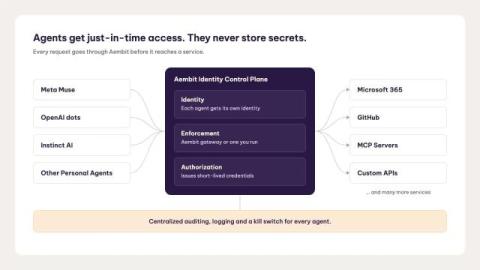
Zero Trust for AI Agents: Enforcing Anthropic's Framework

AI has changed how work gets done. Agents can plan tasks, query enterprise repositories, invoke tools, write code, call application programming interfaces (APIs), and take actions across connected systems. As they work, they create, copy, fragment, transform, and share data across workflows. A perimeter and a one-time authorization decision do not provide enough control for this operating model. An agent can chain permissions, tools, integrations, and data sources while completing a task.

Request, Aggregate, Bypass: How Attackers Can Evade LLM Safety Classifiers

Modern frontier AI models deploy safety classifiers. These are second AI models that sit between the user and the frontier model, evaluating every request in real time. If a request is flagged as harmful, the classifier blocks it before the model can respond. Significant investment and safety model expertise have made these classifiers effective. Anticipating how adversaries circumvent these systems is a security problem that requires different expertise.

Strengthening Network Security for Modern Organizations

Organizations today face a common challenge: networks are growing, wireless connectivity is supporting more users and devices, and security threats continue to evolve. At the same time, IT teams are expected to deliver stronger protection, better performance, and greater visibility without increasing operational complexity. To help organizations meet these demands, WatchGuard is introducing three new additions to its Network Security portfolio: Firebox T175, Prime Security Suite, and AP340 Wi‑Fi 7.

The Cyber Risk Number That Goes to Three Different Committees

An exposure figure is produced once and read three times. The audit committee sees it, the risk committee sees it, and the board sees it, and each is answering a different oversight question. ‍ The figure travels well and the reasoning behind it does not. What arrives at the third reading is a number with no assumptions attached, and by then it reads as a fact. ‍

AI Governance Where the Regulator Also Runs the Market

AI governance evidence is usually prepared for a neutral reader. A regulator with no stake in the market, an auditor with no competing product, an examiner who gains nothing from what the documentation contains. ‍ In securities and derivatives markets that assumption does not hold. Exchanges and clearing organizations register as self-regulatory organizations, and most of them operate the market while regulating its participants. The reader of your evidence is also an operator. ‍