Security | Threat Detection | Cyberattacks | DevSecOps | Compliance

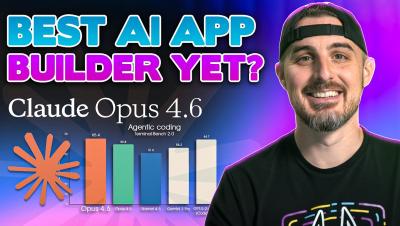
I Built a Production-Ready App in 20 Minutes with Claude Opus 4.6

My boss dropped a bombshell at 4:00 PM: build a secure, production-ready app from scratch by tomorrow morning. Instead of panicking, I put Claude Opus 4.6 to the test. In this video, I walk you through the entire end-to-end process of using an AI agent to architect, code, and debug a full-stack application. We’ll look at "Plan Mode," how the AI handles environment errors (like Windows SQLite issues), and most importantly, how we verified the AI's code for security vulnerabilities using Snyk.

AI Security in 2026 Starts With Identity #cybersecurity #datasecurity #identitysecurity

As AI adoption grows, identity risk grows with it. Dirk Schrader, VP of Security Research at Netwrix, explains why governing human and machine identities is foundational to securing AI systems. How are you governing identity in your AI workflows today?

Intel Chat: OpenClaw saga, React Native Community, Notepad++ & GTIG targets IPIDEA network [291]

In this episode of The Cybersecurity Defenders Podcast, we discuss some intel being shared in the LimaCharlie community. JFrog article. Support our show by sharing your favorite episodes with a friend, subscribe, give us a rating or leave a comment on your podcast platform. This podcast is brought to you by LimaCharlie, maker of the SecOps Cloud Platform, infrastructure for SecOps where everything is built API first. Scale with confidence as your business grows.

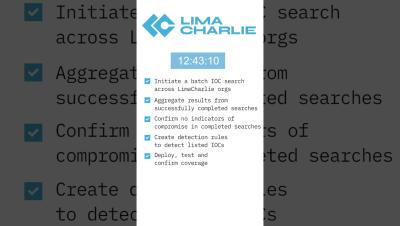
Claude Code converts threat reports into LimaCharlie detection rules #cybersecurity #ai

Feed Claude Code a threat report URL and it'll search for compromise indicators across LimaCharlie tenants, confirm the environment is clean, then it'll create and deploy detection rules. The agent extracts IOCs, generates rule logic, validates through testing, and establishes continuous monitoring. Security teams can operationalize published threat intelligence without manual rule writing.

The Agentic AI Governance Blind Spot: Why the Leading Frameworks Are Already Outdated

Approach any security, technology and business leader and they will stress the importance of governance to you. It’s a concept echoed across board conversations, among business and technology executives and of course within our own echo chamber of cybersecurity as well. For example, the U.S. Cybersecurity Information Security Agency (CISA) has a page dedicated to Cybersecurity Governance, which they define as.

How to Prevent Prompt Injection in AI Agents

In agentic architectures, model behavior is guided by a combination of system prompts, retrieved context, and tool-related inputs rather than a single instruction source. When signals conflict or include untrusted instructions, models must infer which inputs to follow. This ambiguity exposes an opening for prompt injection attacks.

IT Giveth, Security Taketh: The Hidden Cost of Configuration Drift

“IT giveth. Security taketh.” A topic examined in a print interview with Colt Blackmore, co-founder & CTO of Reach Security, written by Dan Raywood at Security Boulevard: ︎ The long-standing friction between IT enablement and security restriction︎ Configuration drift as the quiet divergence between intended and actual state︎ How incremental change accumulates into measurable risk︎ The challenge of maintaining alignment in complex, fast-moving environments︎ Why drift often remains invisible until consequences surface.

Moltbook Data Exposure - The 443 Podcast - Episode 357

This week on the podcast, we cover a recent supply chain compromise involving the popular text editor Notepad++. After that, we discuss a recent vulnerability report in the Moltbook AI social network before ending with a deep-dive review of a recent remote code execution vulnerability in the N8N automation platform.

AI Agents Are The New Detection Problem Nobody Designed For

AI agents now operate as core identities in enterprise environments, authenticating, accessing data, and executing workflows at machine speed. Their flexibility and scale introduce a detection challenge traditional security models were never built to solve. Exabeam has seen this pattern before with insider threat and workload identities. AI agents accelerate the need for identity-centric detection.