Security | Threat Detection | Cyberattacks | DevSecOps | Compliance

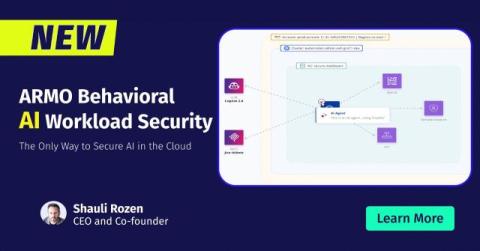
ARMO Behavioral AI Workload Security

AI is not just another workload category. It is the first category of workloads that decides what to do at runtime. And that changes everything about how security must work in the cloud. For years, cloud security evolved around deterministic systems. You deploy code. That code follows defined logic paths. If something unexpected happens, such as a new process, an unusual outbound connection, or privilege escalation, you investigate and respond.


DSPM and Data Discovery: Finding and Classifying Sensitive Data at Scale

Proprietary data is the definitive differentiator in the age of AI. Models can be replicated, infrastructure can be rented, and tools can be replaced. What cannot be easily reproduced is institutional knowledge, customer insight, and strategic intent found in enterprise data. This data must be continuously identified, deeply understood, and actively protected as it changes state, location, and context.

SafeBreach's Evolution into an AI-First Development Team: Part 2

In this second installment of a series on the transformation of SafeBreach’s development organization, VP of Development Yossi Attas details a structured operational workflow that integrates Jira, BitBucket, and Claude Code to turn AI usage from ad-hoc prompting into a rigorous engineering methodology.

Governing Agentic AI: A Practical Framework for the Enterprise

In my previous piece, "The Agentic AI Governance Blind Spot," I laid out what I believe is one of the most critical gaps in the AI governance landscape today: the three most cited frameworks in AI governance, NIST AI RMF, ISO 42001, and the EU AI Act, don’t contain a single mention of agentic AI. Not one reference to autonomous agents, multi-agent systems, or AI that takes actions with real-world consequences. The response to that piece confirmed what I suspected.

Agentic AI Security: MITRE ATT&CK Coverage Analysis in Minutes

LimaCharlie's Agentic SecOps Workspace (ASW) enables true agentic security operations. With us, AI doesn't just advise but actively operates within your security environment. We do this by integrating everything, including AI, on our cloud platform via API. Our approach delivers superior AI security automation capabilities at a fraction of the cost, allowing security teams to scale operations without growing headcount.

What are AI skill-gaps new defenders can leverage? #cybersecurity #ai #podcast

AI skill gaps are a real conversation right now, and Chris Cochran, Field CISO and VP of AI Security at SANS Institute, breaks it down into three practical buckets for defenders who want to stay ahead. Start by figuring out what you can offload to AI: summarization, enrichment, repetitive tasks. Save the deterministic decisions for humans. Then learn how to secure AI itself: Finally, understand governance. Not just the technical side, but what your company is actually trying to do with AI. Security practitioners who can enable the business, not just protect it, become irreplaceable.

VCF 9, Infrastructure, and the AI Revolution

Artificial intelligence is changing the IT landscape in radical, unprecedented ways. It’s rewriting the rules of code generation, automating complex customer service interactions, and providing data insights that used to be impossible to extract, even in recent decades. However, for IT managers and those responsible for keeping the lights on, AI represents a massive shift in infrastructure requirements.

AI Risk Management: Process, Frameworks, and 5 Mitigation Methods

AI risk management is the process of identifying, assessing, and mitigating risks associated with artificial intelligence systems to ensure they are developed and used responsibly. It involves using frameworks like the NIST AI Risk Management Framework to address technical, ethical, and social challenges, including data bias, privacy violations, and security vulnerabilities.