Security | Threat Detection | Cyberattacks | DevSecOps | Compliance

State AI Laws Change Faster Than Compliance Programs

Colorado passed the first comprehensive state AI law in May 2024, and organizations spent the following year building impact assessment processes against it. Those obligations never took effect. The statute was delayed twice, blocked by a federal court, then repealed and replaced by a narrower framework before its own effective date arrived. ‍ Anyone who built a compliance program to that specific statute prepared for a regime that never existed.

Same Numbers, Two Audiences: Insurer and Board

The same quantification run supports two conversations that happen weeks apart. One with a board asking whether the organization is managing cyber risk sensibly. One with an underwriter deciding what to charge for it. ‍ Most guidance treats these as a formatting problem, where the board version gets charts and the submission gets detail.

New Bitsight Research Shows AI Abuse Is Moving Beyond the Jailbreak Prompt

Jailbreak prompts (i.e. prompts designed to remove or bypass the guardrails and rules that govern AI systems, like LLMs) prompts have been circulating for years. At first, a lot of it was pretty simple: copy a prompt, tell the model to ignore its rules, and see what happens. It was also largely noisy, unverified, and often didn’t work. But the noise was still telling us something. Threat actors were beginning to study AI systems the same way defenders were, and over time, the goal started to change.

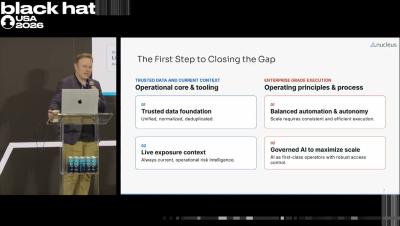
From Findings to Fixes: AI Alone Isn't Enough | Scott Kuffer | Black Hat USA 2026

Everyone is talking about using AI to fight AI. But when it comes to vulnerability management, is that really the answer? In this presentation from Black Hat USA 2026, Nucleus Security Co-founder and Chief Product Officer Scott Kuffer challenges the industry's growing obsession with AI-first security outcomes and explains why organizations need more than autonomous agents, AI-generated prioritization, and endless vulnerability discovery to reduce risk.

What OpenTelemetry Can Actually Tell You About Your AI Agents

‍ The distance between what OpenTelemetry was built for and what AI governance is asking of it shows up in a single number. Distributed tracing descends from Dapper, the 2010 Google paper that gave the industry the vocabulary of traces and spans. Dapper sampled one trace in 1,024. That is ample for finding a latency regression, because a regression recurs and the next sample catches it.

The Second Line Cannot Challenge What It Cannot Evaluate

The three lines model rests on an assumption that holds well in financial risk and poorly in cyber. It assumes the second line can evaluate the first line's work independently, which requires the second line to understand that work at least as well as the people doing it. ‍ In model risk management at a bank, that assumption is satisfied by staffing. The independent review function employs people who can re-derive a model's output and disagree with it on technical grounds.

AI Supply Chain Security: Why an SBOM Cannot Cover It

A software bill of materials works because software changes through a build. Someone bumps a dependency, the pipeline runs, the manifest updates and a scanner compares the new list against known vulnerabilities. Every part of that loop assumes a rebuild is the thing that changes behavior. ‍ AI systems break that assumption at the point it matters most. Editing a system prompt changes what a model does, swaps no dependency, triggers no build and produces no new manifest.

From AI Findings to Action: How Security Teams Should Triage AI-Discovered Vulnerabilities

Security teams didn’t need a headline to tell them that vulnerability volumes continue to be problematic. The CVE database now contains over 354,000 records. Annual disclosure rates have climbed steadily for more than a decade. And remediation backlogs have long been recognized not as an aberration, but as a fixture of the job.

Continuous risk monitoring in third-party risk management is non-negotiable: Here's why

Accelerating security solutions for small businesses‍ Tagore offers strategic services to small businesses. A partnership that can scale‍ Tagore prioritized finding a managed compliance partner with an established product, dedicated support team, and rapid release rate. Standing out from competitors‍ Tagore's partnership with Vanta enhances its strategic focus and deepens client value, creating differentiation in a competitive market.

Human in the Loop: How to Tell If the Review Is Real

Human oversight is the only control in an AI program that can stop working while producing exactly the same evidence as when it worked. A failed encryption control throws errors. A monitoring pipeline that breaks stops delivering alerts. A review step that has become a formality still generates approvals, timestamps and sign-offs, and the compliance file looks identical. ‍ The asymmetry makes the design question secondary to the measurement one.