Security | Threat Detection | Cyberattacks | DevSecOps | Compliance

How to Use the MITRE ATT&CK Framework as a Shared Language for SOC, CTI, GRC, and Leadership

Picture the first meeting after a serious security event. The Security Operations team is talking about alerts, detections, and lateral movement. Threat Intelligence is talking about adversary tradecraft and known campaigns. Governance and Risk is talking about control gaps, exposure, and business risk. And leadership? They only care about how bad this event is, and what the team is doing about it. Security teams often agree on the mission: deter and stop threat actors at all costs.

CI/CD security: threat modeling using a MITRE-style threat matrix

Source code management (SCM) and CI/CD pipelines have become the industry standard for automating software delivery. But from the time a code change enters your SCM until it’s deployed, it’s susceptible to changes and reconfigurations that can go so far as to modify the pipeline itself. If you’re not proactively securing your CI/CD system, attackers can use it to grant themselves permissions, access secrets, and ship malicious code.

Episode 7 - Practical AI for Zeek, MITRE, and Security Docs

In Episode 7 of Corelight DefeNDRs, join me, Richard Bejtlich, as I sit down with Dr. Keith Jones, Corelight's principal security researcher, to discuss the practical applications of AI in enhancing network security. We delve into how large language models (LLMs) can assist in cleaning up documentation and generating Zeek scripts, sharing insights from our extensive experience in incident response and coding. Keith reveals the challenges and successes he has encountered using LLMs to streamline processes, including their role in analyzing MITRE techniques.

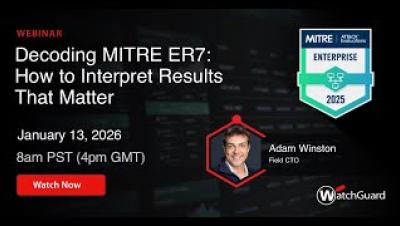
Decoding MITRE ER7: How to Interpret Results That Matter

MITRE ATT&CK Evaluations attract strong attention across the cybersecurity industry by providing detailed, transparent data on how endpoint security solutions behave under real attack conditions. However, the depth of the results often makes them difficult to interpret and compare meaningfully. Join Field CTO Adam Winston as he decodes WatchGuard’s MITRE ER7 results and learn how to weigh key metrics to determine real-world security effectiveness and efficiency.

MITRE ER7 Explained: From Detection to Operational Efficiency

MITRE ATT&CK ER7 results are often reduced to simple headlines: detection percentages, prevention rates, or “100% coverage” claims. But those numbers alone don’t explain how a security platform actually behaves when an attack unfolds, nor how much operational effort is required to manage it. To understand the real impact of ER7 results, you need to look at detection efficiency and operational efficiency, not just raw coverage.

Decoding the 2025 MITRE ATT&CK Evals: A Call for Clarity and a Guide for Analysts

The latest MITRE ATT&CK Enterprise Evaluations are out, featuring scenarios that emulate sophisticated actors like Scattered Spider and Mustang Panda. While every release of the findings is a significant event for the security community, this year’s evaluation highlights both new and recurring concerns for security professionals.

Advancing AI Security: Zenity's Contributions to MITRE ATLAS' First 2026 Update

MITRE ATLAS has become a critical resource for cybersecurity leaders navigating the rapidly evolving world of AI-enabled systems.Traditional threat models are built for human-initiated workflows, APIs, and infrastructure, so they are no longer sufficient to describe modern AI attacks..

Advancing MITRE ATLAS AI Security Through Zenity's Contributions

MITRE ATLAS (Adversarial Threat Landscape for Artificial-Intelligence Systems) is a globally recognized AI security framework that catalogs adversarial techniques targeting artificial intelligence systems. Similar in structure to MITRE ATT&CK but purpose-built for AI, machine learning, and agentic systems, ATLAS translates abstract AI risks into concrete, actionable attack techniques that security teams can monitor and mitigate.

The Ultimate 101 Guide to MITRE ATLAS

Artificial intelligence is increasingly ingrained in every aspect of healthcare diagnostics, financial systems, autonomous vehicles, and critical infrastructure. Still, the reality has set in: these systems are under threat unlike anything we have seen, and existing cybersecurity frameworks were never designed to handle AI-specific threats.

Why Knowing ATT&CK Isn't Enough: Mapping Real Control Coverage with Reach

Security teams know the attack techniques. What they don’t always know is how those techniques actually land in their environment. Reach maps your existing controls to MITRE ATT&CK (and D3FEND) and shows—visually—︎ which techniques are covered︎ which tools provide that coverage︎ and where real gaps exist Because “we have the tool” isn’t the same as “the technique is stopped.”