Security | Threat Detection | Cyberattacks | DevSecOps | Compliance

Alex Stamos has 23 minutes to stop an AI chatbot leaking data (Live Tabletop Exercise)

What does a security leader actually do when an AI chatbot starts confidently revealing customer data that was never supposed to see the light of day? Alex has spent his career at the intersection of security and the hardest problems in tech—Chief Security Officer at Yahoo, Facebook, and SentinelOne, founder of the Stanford Internet Observatory, and now Chief Product Officer at Corridor, a startup focused on the security and safety of AI coding agents. If anyone knows what it looks like when AI ships faster than security can keep up, it’s him.
Episode 2: Least privilege access

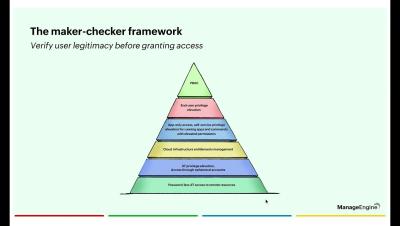
In this episode, we'll walk you through one of the core tenets of PAM360: eliminating standing privileges. You will learn how to replace permanent administrative access with just-in-time (JIT) privilege elevation, reduce your attack surface, and enforce least-privilege access across your endpoints and critical systems. We will also break down PAM360's privilege elevation framework—built on a maker-checker model and policy-based access—so you can configure and scrutinize access requests, automate approvals, and enable dynamic controls for applications and user actions.

Optimize Microsoft Entra ID Conditional Access | Reach Security

Which of your users can reach a sensitive app without ever hitting MFA? Most security teams can't answer that with confidence. Microsoft Entra ID and Conditional Access is powerful. But exclusions stack up, MFA coverage drifts, and risk-based protections go unused. This creates openings for fast-moving AI-powered attackers. Reach continuously validates your controls against your security intent, closes the gaps, and proves the risk reduction.

Intel Chat: Cisco CUCM exploited, ransomware profiles, Gamaredon & AI agent phishing [335]

Intel Chat with Matt Bromiley and Chris Luft. Matt and Chris break down four stories from the week in threat intel: Chapters: The Cybersecurity Defenders Podcast — a podcast about cybersecurity and the people that keep the internet safe. New episodes drop weekly. Subscribe wherever you listen.

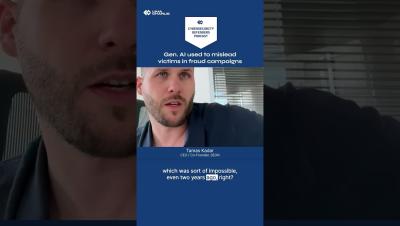
Gen. AI used to mislead victims in fraud campaigns

It is almost impossible to trust the source of an image or video anymore. On The Cybersecurity Defenders Podcast, Tamas Kadar, CEO and Co-Founder of SEON, explains how generative AI has reshaped what fraudsters can pull off. Setting up sophisticated fraud operations no longer requires coding skills, and synthetic identities and deepfake documents have become convincing enough that visual verification alone is no longer reliable.

From ISDN to AI - Two Veterans on How Defence in Depth Has Changed

Defence in depth has evolved every time the technology landscape has shifted. The internet, virtualisation, cloud, SaaS. AI is the next shift, and the old model isn't keeping up. Welcome to Razorwire, the podcast where we share our take on the world of cybersecurity with direct, practical advice for professionals and business owners alike. I'm Jim and in this episode, I'm joined once again by Martin Voelk, co-founder of SpartanX and an ethical hacker with nearly 26 years in cybersecurity.

From prompt to action: Al Security with Salt Security and CrowdStrike

As enterprises accelerate adoption of Generative AI, the security perimeter is rapidly expanding. This creates a new, largely unprotected attack surface: the Agentic Action Layer. In this on-demand webinar, @CrowdStrike and Salt Security introduce an AI-native security architecture that spans the full chain of intent-to-action. Learn how CrowdStrike Falcon AIDR protects the model runtime, prompts, inference, and LLM behavior, while Salt Security governs and defends the APIs, MCPs, and services where AI actions actually occur.

The MemcycoFM Show: Ep25 - How to Detect Brand Impersonation: Key Signals for Security Teams

In the recently published blog from @Memcyco titled 'How to Detect Brand Impersonation: Key Signals for Security Teams', we discussed brand impersonation detection, the process of identifying fake domains, cloned brand experiences, and the exposure signals that show attackers are using a trusted brand to deceive customers, employees, or partners. For security teams, the harder problem is not finding every impersonation asset. It is knowing which signals indicate live user exposure and which ones should change the response.

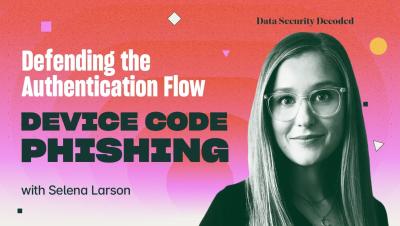
Defending the Authentication Flow: Device Code Phishing with Selena Larson

Selena Larson, Staff Threat Researcher and Lead, Intelligence Analysis and Strategy at Proofpoint and Host of the DISCARDED podcast, joins host Caleb Tolin to detail the specific mechanics of device code phishing campaigns, revealing how adversaries exploit legitimate communication structures to capture administrative and enterprise access. The discussion centers on the rapid commercialization of cybercrime, highlighting the leak of specialized kits in late 2025 that catalyzed the democratization of sophisticated technical exploits.

Ep. 4: The Sony Playbook

It’s been nearly 12 years since North Korea launched its crippling attack on Sony Pictures Entertainment over a Seth Rogen film. Most Americans remember the celebrity leaks, the embarrassing emails, the Hollywood spectacle of it all. What they missed was the playbook: Why simply hack an organization when you can bleed reputations dry? Turn stolen data into psychological warfare. It was a model that would soon echo everywhere from Russian intelligence operations to modern ransomware gangs.