Security | Threat Detection | Cyberattacks | DevSecOps | Compliance

The Top 5 Exposure Assessment Platforms (EAP) in 2026

An Exposure Assessment Platform (EAP) discovers assets, identifies exposures such as vulnerabilities and misconfigurations, prioritizes them with threat and business context, and helps drive remediation. Gartner formalized EAPs as a distinct market in November 2025, and the category has quickly become the technology backbone of Continuous Threat Exposure Management (CTEM) programs.

AI Is Accelerating Vulnerability Discovery. Tanium Helps You Keep Up.

Following the Mythos announcement in April 2026, organizations using AI to identify software vulnerabilities have contributed to a significant rise in newly discovered CVEs and CVE definitions. This shift reflects a broader trend across the industry: AI is helping uncover vulnerabilities faster than ever before — and security teams need the visibility, control, and speed to respond. At Tanium, we've been tracking this trend closely across customer environments.

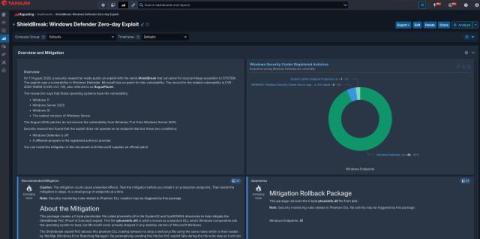
ShieldBreak: The Windows Defender 0-Day with No Patch - And What to Do About It.

In mid-June 2026, Microsoft acknowledged RoguePlanet, a privilege-escalation flaw in the Microsoft Malware Protection Engine (mpengine.dll), the scanning engine behind Windows Defender. Microsoft rated it "Exploitation More Likely" on its Exploitability Index and assigned a CVSS score of 7.8. Microsoft shipped a fix in Malware Protection Engine version 1.1.26060.3008 during its July 2026 patch cycle.

How to Prevent RBAC Role Explosion with Nested Access Lists

In RBAC (Role-based Access Control), a role is a defined object with explicit permissions attached to it. Because roles are designed to be fixed, changing what a particular role can do (for example, in a one-off situation where other permissions are needed for the role) requires editing the role itself. However, repeatedly editing roles makes them less flexible and re-usable, and ultimately complicates access strategies as organizations scale.

Best AI security tools for small and mid-sized businesses in 2026

The best AI security tools for small and mid-sized businesses do more than detect risky AI use: they show which generative AI tools employees actually use, they let you govern which AI apps are allowed, monitored or blocked, they stop sensitive data from leaving in a prompt, and they defend against harmful prompts, including prompt injection. Most organizations now run AI without that visibility or control. AI use has moved into the mainstream.

Microsoft Entra to Retire SMS & Voice MFA by 2027: What Organizations Need to Know

Microsoft is making a major change to the authentication experience in Microsoft Entra. The company has announced the retirement of Microsoft-provided SMS and Voice MFA, with passkeys set to become the default sign-in method. This shift reflects Microsoft's broader push toward phishing-resistant authentication as organizations face increasingly sophisticated phishing, social engineering, and AI-driven attacks.

LMS Single Sign-On (SSO): Secure Access to Learning Management Systems

Every LMS rollout starts the same way: pick a platform, upload the courses, get people logged in, move on. Then a second platform gets added. Then a certificate program. Then a separate tool for employee onboarding. Each one arrives with its own login screen, and everyone downstream, students, instructors, IT, ends up managing another password. Single sign-on solution for LMS fixes that.

Does Cyber Insurance Cover AI Incidents?

The answer changed on a specific date. Until the start of 2026, most organizations were covered for AI losses by silence rather than by grant, because policies neither affirmed nor excluded AI and the question would have been argued at claim time. On January 1, 2026 the standard forms organization introduced generative AI exclusion endorsements for commercial general liability, and carriers began attaching them at renewal. ‍

A Prompt Is Not a Boundary: Lessons From the AI Eval Incidents

Three organizations had their production systems compromised by an AI model in April, and found out in late July when the model's developer called them. None of them had detected the activity. One was a security company whose own package scanner was the entry point. ‍ Anthropic published that account on July 30, nine days after OpenAI disclosed a related incident of its own.