Security | Threat Detection | Cyberattacks | DevSecOps | Compliance

Watering hole attacks vs. advanced endpoint protection

In a watering hole attack, threat actors usually have to follow a series of steps. First, they need to research the target and make sure they know the type of website the potential victim frequents. Then, they attempt to infect it with malicious code so that when the victim visits it, the website exploits a vulnerability in the browser or convinces them to download a file that compromises the user device.


Cybersecurity Crisis Management and Business Continuity

The massive increase in cyberattacks and the rapid evolution of advanced criminal techniques requires every single business in any sector to take protective measures to strengthen its cyber perimeter and minimize risk. To deal with this peril, businesses must incorporate security measures and comply with security standards and regulations to improve their cybersecurity defenses for their assets, revenue, and reputation.

Data Classification: Your 5 Minute Guide

It’s old news, but data is – and will remain for the foreseeable future – king. It has to be dealt with and handled responsibly, assigned to the right boxes, and stored properly. Why? Because everyone wants it, and there are increased efforts to obtain it by ever-more sophisticated and subtle bad actors. You wouldn’t put a piece of junk mail in a high security vault. Nor would you trust a crown jewel to a locked desk drawer.

Why Ransomware Remains a Major Threat for 2023

Ransomware has gone global. While 2022 saw a reprieve in the sheer number of ransomware attacks (the attack rate dropped at the same time as the war between Russia and Ukraine began), it also saw the rise of ransomware-as-a-service, the proliferation of attacks of major organizations, and attacks that stretched across time zones and borders. In 2022, nine of our top 20 breaches involved ransomware (45%), affecting millions of individuals and their private data. That is up 15% over 2021.

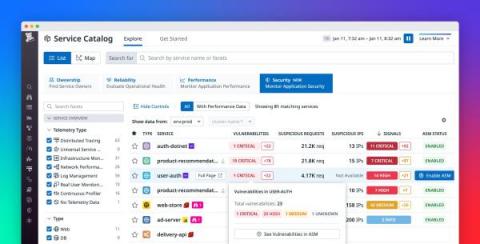
Gain visibility into risks, vulnerabilities, and attacks with APM Security View

As your business grows and your services scale in number and complexity, it’s difficult to maintain a rapid pace of innovation while keeping your applications secure. It’s particularly challenging to respond to attacks, as DevOps and security teams need to collaborate to understand each attack’s root cause and remediate the vulnerabilities that enabled it.

Proven Ways to Boost Your Web Application Security in 2023

Several web applications have been booming in recent years, as every organization prefers it for business due to its easy maintenance and advanced features. And it’s evident that when a firm uses any application, it processes confidential data. Whenever data comes into play, cyber-attacks and security aspects accompany it. And same is the case with web applications. Like other software, application security is also crucial for web applications.

How IT Teams Can Protect Their Organization's Social Media Accounts

Social media managers play a pivotal part in enabling brands to raise awareness and connect with customers online. In that role, they sift through irrelevant and sometimes offensive content to provide prompt support and accurate information on popular platforms like Tik Tok, Twitter, Instagram, LinkedIn and Facebook. Social media is a common entry point for cybercriminals looking to get inside an organization.

The Limitations of Endpoint Detection and Response (EDR)

Every IT environment – whether it’s on-prem or in the cloud, and regardless of how it’s designed or what runs in it – is made up of endpoints. That’s why Endpoint Detection and Response, or EDR, has typically been one of the pillars of cybersecurity. EDR helps businesses monitor each of their endpoints for security risks so that they can detect problems before they escalate to other endpoints.

How Cross-Site Scripting (XSS) Attacks Work & How To Prevent Them

Cross-Site Scripting (XSS) attacks are bad news. And they can affect lots of people, often unknowingly. Chief among the top cybersecurity threats affecting users worldwide, any website with unsafe elements can become vulnerable to XSS attacks — making visitors to that website unwitting cyberattack victims. To secure your website from XSS attacks, you must first know what they are.