Security | Threat Detection | Cyberattacks | DevSecOps | Compliance

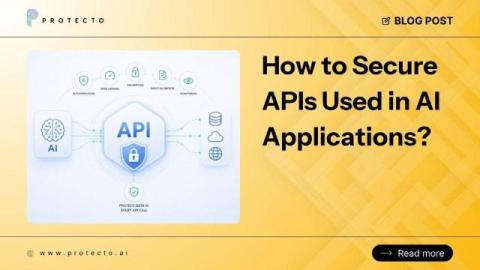
How to Secure APIs Used in AI Applications?

Every AI application runs on APIs. They carry prompts, responses, customer data, and credentials between your models, databases, and third-party services. To secure APIs in AI applications, you need strong authentication, rate limiting, encryption, input validation, and continuous monitoring. But AI adds a layer most API security checklists miss: the data inside the API calls. That data needs protection too.

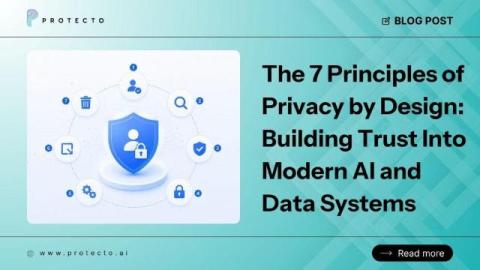
The 7 Principles of Privacy by Design: Building Trust Into Modern AI and Data Systems

Data privacy is not just a checkbox for compliance requirements. It has become a core business expectation. Customers now want to know how companies collect, store, process, and protect their data. At the same time, global regulations like the GDPR and CCPA have made privacy a critical part of product development. According to a report by the Cisco Consumer Privacy Survey, 99% of companies saw measurable benefits by investing in privacy.

Best AI Red Teaming Tools: Top 7 in 2026

There was a time when “AI red teaming” sounded like a novelty. Now, it’s fast becoming table stakes. If your organization is shipping machine learning or LLM-powered systems into the real world (especially in sensitive domains), you need to know how those systems behave under pressure. That’s where AI red teaming tools come in. These tools help teams stress-test AI the way it will actually be used (and misused).

OpenAI's o1-preview Highlights New Security and Infrastructure Challenges in AI Operations

Artificial intelligence continues to evolve beyond simple language generation, with developers increasingly focusing on advanced reasoning capabilities. OpenAI's release of the o1-preview model in September 2024 marked another step in this direction, introducing a system designed to spend more computational effort on solving complex problems before generating answers.

Top AI App Maker Platforms for Startups and Small Businesses

Building a software application used to require a full development team, a serious budget, and months of work. For most startups and small businesses, that was simply out of reach. But things have changed dramatically over the past few years. Today, an AI app maker can help almost anyone turn an idea into a working product without writing a single line of code.

The Vanta AI Quality Eval Maturity Model

Accelerating security solutions for small businesses‍ Tagore offers strategic services to small businesses. A partnership that can scale‍ Tagore prioritized finding a managed compliance partner with an established product, dedicated support team, and rapid release rate. Standing out from competitors‍ Tagore's partnership with Vanta enhances its strategic focus and deepens client value, creating differentiation in a competitive market.

One Poisoned AI Agent Hijacks Your Entire Pipeline #aiagents #mcp #zerotrust

In a multi-agent AI workflow, one agent's output becomes the next agent's input. That's the design. It's also the attack surface. Researchers have demonstrated that a single poisoned output can cascade across an entire pipeline — triggering unauthorized behavior, data exfiltration, and control flow hijacking across chained MCP processes. The attack class is called toxic flows. And every one of them passes classical zero trust checks.

A Fake MCP Server Just Exposed Your WhatsApp History

A security researcher introduced a malicious MCP server into an environment that already had a legitimate WhatsApp integration—and watched it silently expose message history without any user approval. The technique is called a rug pull. The server advertised one behavior at installation. On second usage, it switched to something else entirely. The approval was real. The thing you approved was not. This is what trust decay looks like in practice—and it passes every classical security check.

Ep. 62 - Zero Trust Breaks Against MCP: Why "Verified" No Longer Means Safe

Most enterprises assume their Zero Trust architecture covers their AI agents. It doesn't. Hosts Tova Dvorin and Adrian Culley break down why zero trust breaks against the Model Context Protocol (MCP)—and why "verified" no longer means "safe." They unpack trust decay, the WhatsApp and GitHub MCP exploits, rug-pull tool poisoning, CVE-2025-49596, and the rise of "zero standing trust," then close with three moves for CISOs this quarter: inventory your MCP estate, mandate authentication, and validate your controls.