Security | Threat Detection | Cyberattacks | DevSecOps | Compliance

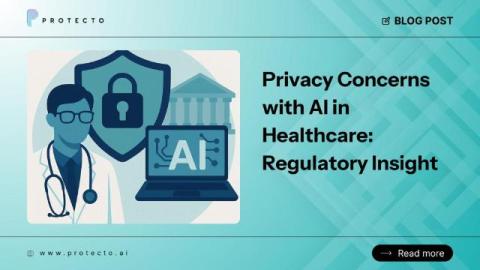
Privacy Concerns with AI in Healthcare: 2025 Regulatory Insight

Healthcare has always been one of the toughest environments for maintaining privacy. Now add AI assistants, retrieval-augmented generation, and multimodal inputs like clinical images and voice notes. Sensitive information travels farther and faster than ever before, and the fallout from a single leak can be devastating, affecting clinical, legal, and reputational aspects. The question for 2025 is simple: how do we harness the advantages of AI without compromising private health data?

LLM Security in 2025: Risks, Mitigations & What's Next

Large language model (LLM) security refers to the strategies and practices that protect the confidentiality, integrity, and availability of AI systems that use large language models. These models, such as OpenAI’s GPT series, are trained on vast datasets and can generate, translate, summarize, and analyze text. However, like any complex software component, LLMs present unique attack surfaces because they can be influenced by the data they process and the prompts they receive from users.

Is This the Best Coding Model in the World? Claude Sonnet 4.5

In this episode of our AI Coding Tools series, we test Claude Sonnet 4.5 to see if it can build a secure note-taking app. The model claims to be the best in the world — but does it live up to the hype? We’ll cover how it codes, where it shines (or struggles), and how it stacks up against other AI coding assistants.

Verifiable AI: Policy Management for Next-Gen AI Security

As AI agents increasingly automate complex B2B workflows, how do organizations ensure security and compliance? In this segment, A10 Networks' security experts, Jamison Utter, Diptanshu Purwar, and Madhav Aggarwal, dive into the critical steps for securing AI deployments. Diptanshu emphasizes the importance of integrating AI agents into existing governance platforms, leveraging systems such as role-based access control and policy management.

Security Leaders Cite AI-Driven Phishing Attacks as a Top Concern

A new report has found that nearly 40% of security leaders believe their organizations are least prepared for phishing and other social engineering attacks, Help Net Security reports. According to the report from VikingCloud, these concerns are driven by the increasing use of AI tools to assist in cyberattacks. “Generative or agentic AI-driven phishing attacks (51%) are leadership teams’ top concern when it comes to new cyberattack techniques,” the report says.

6 Ways Technology Strengthens Supply Chain Compliance and Security

More than 80% of global trade by volume moves through maritime routes, according to the United Nations Conference on Trade and Development. Each container crossing borders carries not just goods, but pages of documentation, compliance checks, and security verifications. Managing all this manually leaves room for costly mistakes and unnecessary delays.

How AI Is Reshaping Cybersecurity in K12

It is first period in a busy school district. Teachers are opening their learning management systems to take attendance, preparing lesson slides, and answering a few messages from parents. Students are logging into Chromebooks after sneaking in a final Snap before leaving their phones in lockers. In the finance office, payments are being processed.

8 fundamental AI security best practices for teams in 2025

Organizations worldwide are increasingly developing or implementing AI-powered tools to streamline operations and scale efficiently. However, the benefits come with unpredictable risks unique to AI that need to be mitigated with the right safeguards. ‍ One of the biggest AI security challenges is the lack of formalized oversight. According to Vanta’s State of Trust Report, only 36% of organizations have AI-informed security policies in place or are in the process of building them.