As AI makes credential attacks more sophisticated, Keeper Security protects you with one master password that unlocks your encrypted vault, while also generating strong, unique passwords that are difficult to crack.
There's a version of the LLM safety conversation that stays comfortably abstract - AI alignment, existential risk, theoretical failure modes that matter at a scale most organizations will never reach. That conversation is important, but it's not the one most product and technology leaders need to be having right now. The one they need to be having is more immediate and considerably more practical: how the specific decisions made during llm training services directly shape whether the model you deploy is one your organization can actually stand behind.
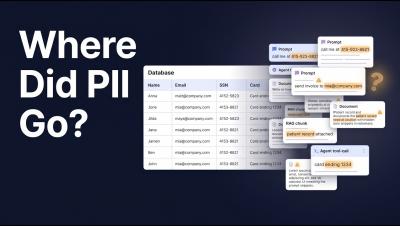
Sensitive data used to live in predictable places database columns, known field names, structured rows. That changed when data moved into documents. And it changed again when AI workflows arrived. In this video, we walk through why detecting sensitive data in AI pipelines is fundamentally different from traditional data discovery, and why the old approaches break. We cover the four failure modes that make detection hard in AI workflows.
Building guardrails for AI agents sounds like a policy problem but it is actually a data problem. You cannot enforce boundaries on behavior you cannot see. And you cannot govern identity for actors you have not discovered. That dependency chain is what most enterprise security programs miss in 2026, and it is where exposure quietly accumulates. A human employee who mishandles sensitive data creates a containable event. An AI agent with the same permissions creates a different problem.
Firewalls are the single most common source of misconfiguration-related breaches, yet they get changed a hundred times a week and audited once a quarter. This is the network security gap AI attackers exploit first. Endpoint gets the budget. Identity gets the roadmap. The firewall gets changed constantly and reviewed rarely. It is also the control most tied to breaches: 42% of security teams pinned a firewall misconfiguration to a breach or near miss last year, ahead of EDR at 40% and identity at 39%.
Organizations are fully onboarded in multi-cloud environments (AWS, Azure, GCP), but transitioning from traditional on-prem security to the cloud poses a significant challenge. Cloud security teams now need to collaborate with traditional network engineering teams, each with different objectives, to bridge the gap.
Shadow IT used to mean employees spinning up unsanctioned software-as-a-service (SaaS) apps that stored company data without approval. Today, shadow MCP and unsanctioned LLM integrations represent the next evolution, and they're more dangerous. Model context protocol (MCP) servers don't merely store data; they act on it, executing code, calling APIs, and accessing internal tools on behalf of AI agents that developers connect with a config file.
Egnyte AI surfaces insights from an organization's documents for regulated industries—life sciences, financial services, architecture, engineering, and construction—and does that within existing permissions and compliance controls. Our AI Assistant is the conversational front door. Ask a question about your documents in plain language, summarise a contract, find the latest version, pull a compliance clause, and get an answer grounded only in the files you're permitted to see.
Most security tools describe what has already happened. The harder question is what happens next: which exposures an attacker will chain together, and where they will get in. CloudSEK's Global Threat Landscape Report 2025 describes cybercrime as a structured, industrial ecosystem built on stolen credentials, access marketplaces, and coordinated attack chains, and frames the response as a shift from reactive defense toward predictive resilience.
Warehouses are built for motion. Trucks arrive, products move, employees shift between zones, and valuable inventory often sits in multiple areas at once. That constant activity creates opportunities, but it also creates risk. For operators who need better visibility, safer access, and stronger protection, it can make sense to hire ADR Security when planning a system that supports daily warehouse operations without slowing them down.