Security | Threat Detection | Cyberattacks | DevSecOps | Compliance

UEBA (User and Entity Behavior Analytics): complete guide to detection, use cases, and implementation

User and entity behavior analytics (UEBA) is a cybersecurity technology that uses machine learning and risk scoring to detect threats by analyzing user and entity behavior patterns. UEBA establishes behavioral baselines for users, devices, and applications, then identifies anomalies that may indicate insider threats, compromised accounts, or advanced attacks that traditional security tools miss.

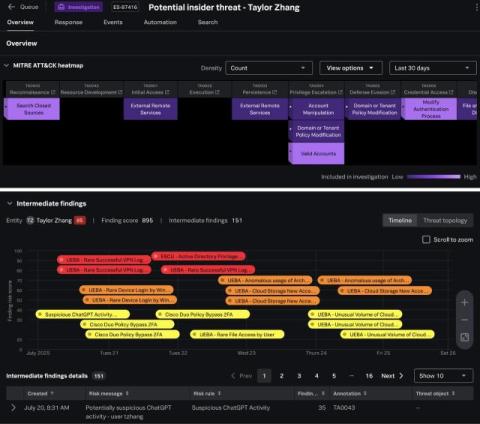
UEBAenabled SIEM use cases: Stopping insider threats before they strike

Insider threats remain one of the most challenging security risks organizations face. Unlike external attackers who must breach perimeters, insiders already possess legitimate access to critical systems and data. They understand security controls, know where valuable assets reside, and can operate under the radar of traditional rule-based detection systems for extended periods.

Strengthen SOC Defenses with Native UEBA in Splunk Enterprise Security

At.conf25, we announced how Splunk Enterprise Security (ES) has transformed to today’s AI-powered SecOps platform—unifying industry-leading technologies across SIEM, SOAR, User and Entity Behavior Analytics (UEBA), threat intelligence, and detection engineering with purpose-built AI across the entire Threat Detection, Investigation, and Response (TDIR) workflow—empowering Security Operations Centers (SOCs) to end analyst fatigue, deliver faster security outcomes, reduce risk, and build r

How UEBA Enhances Threat Detection Across the Network Layer

11 days. That’s the global median dwell time for attackers in 2024,down from 26 days when external entities notify, but still long enough to cause significant damage. Your firewalls? They’re stopping known signatures. Endpoint tools see individual machines. But the network layer, where attackers actually move around, escalate privileges, steal sensitive data, that’s often a blind spot.

The Rise of AI-Generated Attacks: Why UEBA is the Best Defense

The cybersecurity industry is facing a new challenge: AI-generated attacks. With the rapid advancement of generative AI, cybercriminals now have access to sophisticated tools that enable them to craft highly targeted attacks with minimal technical expertise. Unlike traditional attack methods that require deep programming knowledge, AI-driven attacks allow even non-technical malicious actors to create malware, exploit scripts, and launch phishing campaigns with ease.

Traditional Security Can't Stop LOTL Attacks. Exabeam UEBA Destroys Them.

Attackers are becoming more sophisticated and stealthier. Their methods are more advanced. Of these advanced methods, living-off-the-land (LOTL) attacks are the sneakiest and most effective. By using legitimate tools and processes already in your environment, malicious actors can get what they want without being seen. But with the Exabeam New-Scale Security Operations Platform and our industry leading user and entity behavior analytics (UEBA), security teams can stop them.

Your SIEM is Lying to You: Why You Need UEBA to Uncover the Truth

The way we detect cyber threats has come a long way, but let’s be real—traditional methods have serious blind spots. Back in the day, we relied on correlation rules—basic if-this-then-that logic—to flag suspicious activity. It worked… sort of. But today, exponential data growth has limited the effectiveness of using only correlation rules to detect threats. The result?

Beyond UEBA: Elevating Insider Risk Management with Behavioral Intelligence

Insider risk management is more critical than ever as human error and insider threats drive escalating security breaches. While many organizations have adopted User and Entity Behavior Analytics (UEBA) to monitor potential risks, relying solely on UEBA may fall short of the depth needed to stay ahead of these increasingly complex threats.

Reduce False Alerts - Automatically!

Analysts rely on User and Entity Behavior Analytics (UEBA) tools to track anomalies, investigate incidents, and respond to cybersecurity threats. However, the varying nature of user and entity behaviors across different organizations means that predetermined thresholds often fail to account for unique baselines. Even within the same environment, temporal variations can cause significant differences in monitoring signals.

UEBA Superpowers: Simplify Incident Investigations to Increase SOC Efficiency

In an era marked by an increasing volume and sophistication of cyber threats, the efficiency of your SOC operations has become more important than ever. SOCs are flooded by a daily barrage of attacks and alerts, with a significant portion being false positives, leading to alert fatigue and the potential for genuine threats to slip through the cracks.