Security | Threat Detection | Cyberattacks | DevSecOps | Compliance

DNS anomaly detection with machine learning: How ManageEngine DDI Central stops threats before they start

Most breaches don't announce themselves; they whisper. A subtly malformed DNS query here. A DHCP lease request that looks almost normal there. A client that suddenly requests a domain no one in your organization has ever heard of. By the time these whispers become alarms on a SIEM dashboard, attackers have often already moved laterally, exfiltrated data, or cemented persistence. In traditional DNS, DHCP, and IPAM (DDI) setups, these signals are buried under millions of legitimate transactions.

Our ongoing commitment to privacy for the 1.1.1.1 public DNS resolver

Exactly 8 years ago today, we launched the 1.1.1.1 public DNS resolver, with the intention to build the world’s fastest resolver — and the most private one. We knew that trust is everything for a service that handles the "phonebook of the Internet." That’s why, at launch, we made a unique commitment to publicly confirm that we are doing what we said we would do with personal data.

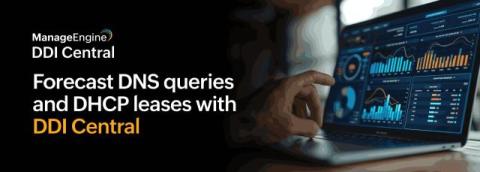
Data-driven forecasting: Plan your network growth and optimize resource usage with DDI Central's DNS and DHCP forecasting

DNS and DHCP services in an organization’s network experience constant fluctuations in query spikes, lease requests, and client connections over time. Network administrators must continuously monitor these patterns to ensure service stability and availability. However, in fast-paced and growing networks, a proactive approach is far more effective than a reactive one. This allows teams to identify and resolve service-related issues before they lead to network disruptions or IP exhaustion.

Dangling DNS in the AI Era: The Silent Attack Surface Expanding Beneath Your Feet

Artificial intelligence is accelerating digital transformation at an unprecedented pace. New AI-driven applications, copilots, data pipelines, APIs, and cloud services are spinning up faster than ever before. But while innovation moves at machine speed, governance often lags behind. The result? A rapidly expanding external attack surface filled with forgotten assets, abandoned cloud resources, and misconfigured DNS records — many of them quietly waiting to be hijacked.

Using NQE to Consistently Validate DNS Configuration During Network Changes

DNS is foundational to almost every application, yet it is often treated as background configuration rather than a critical dependency. During network changes, DNS settings are easy to overlook. A single device pointing to the wrong resolver, missing a required DNS entry, or retaining a legacy configuration can cause application failures that appear unrelated to the original change.

Dangling DNS Is Off the Hook

If your organization uses public cloud services or frequently spins up short‑lived web assets, there’s a good chance you already have at least one "dangling"DNS record. It's surprisingly easy to create one, and even easier to forget it exists. But a single forgotten record can give attackers a ready-made subdomain to host phishing pages, allow them to plant malware, or hijack your brand's reputation–without ever touching your infrastructure.

Delegated DNS validation: proving domain ownership without exposing credentials

It seems like every service wants proof you control your domain. Certificate authorities need it to issue certificates. Email platforms need it to authorize sending. Analytics needs it to gather data. Just add this magic TXT record to your DNS, wait for propagation, click verify. It works fine when it’s a one-time setup, but certificate lifetimes are dropping to 47 days, and you won’t be able to keep up on that schedule.

Episode 6 - Detecting DNS Covert Channels in the Wild (Part 2)

In Episode 6 of Corelight DefeNDRs, we delve deeper into the fascinating world of DNS covert channels with Vern Paxson, our chief scientist and co-founder. Continuing from our previous discussion, Vern shares his insights on techniques developed to detect these stealthy channels utilized by intruders to evade security measures. We explore the innovative approach of leveraging time series analysis of DNS lookups, how to distinguish benign traffic from potential threats, and the real-world implications of our findings across significant datasets.

Domains, DNS and Forgotten Risks in Modern Security Stacks

When most cybersecurity teams map their threat landscape, they start with endpoints, users, cloud environments and network layers. It's a solid strategy - but it leaves one critical layer wide open: the domain and hosting infrastructure everything else depends on.

Episode 5 - Detecting DNS Covert Channels in the Wild (Part 1)

In Episode 5 of Corelight Defenders, I, Richard Bejtlich, engage with Corelight's co-founder and chief scientist, Vern Paxson, to delve into the intricate world of DNS covert channels. We explore how adversaries exploit DNS lookups to silently communicate within tightly controlled enterprise environments. Vern explains various methods attackers may use, from encoding data in seemingly benign domain names to manipulating the timing of requests. Our discussion highlights the challenges of detecting these covert channels, especially in the presence of network monitoring.