Security | Threat Detection | Cyberattacks | DevSecOps | Compliance

Dry Run: Your Kubernetes network policies with Calico staged network policies

Kubernetes Network Policies (KNP) are powerful resources that help secure and isolate workloads in a cluster. By defining what traffic is allowed to and from specific pods, KNPs provide the foundation for zero-trust networking and least-privilege access in cloud-native environments. But there’s a problem: KNPs are risky, and applying them without a clear game plan can be potentially disruptive.

You've Embraced Kubernetes. Now Comes the Hard Part: Protecting Kubernetes

You’ve made the leap. Kubernetes is up and running. You’ve reduced your hypervisor footprint, containerized your workloads, and unlocked new levels of agility. But now the Day 1 operations are behind you—the real challenge surfaces: protecting Kubernetes. How do you protect this dynamic, fast-moving environment without slowing down your team, racking up hidden costs, or duct-taping together a fragile backup system?

Calico Whisker & Staged Network Policies: Secure Kubernetes Workloads Without Downtime

Rolling out network policies in a live Kubernetes cluster can feel like swapping wings mid-flight—one typo or overly broad rule and critical traffic is grounded. Calico’s Staged Network Policies remove the turbulence by letting you deploy policies in staged mode, so you can observe their impact before enforcing anything.

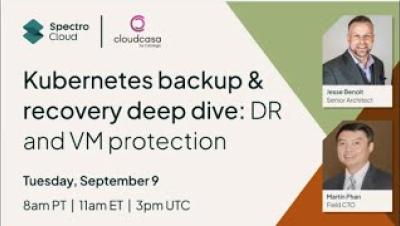
How to Integrate CloudCasa with Spectro Cloud Palette for Kubernetes Backup, DR & Migration

In this technical demo, Martin Phan, Field CTO at CloudCasa, walks you through how to integrate CloudCasa, a powerful Kubernetes backup and disaster recovery solution, with Spectro Cloud Palette. Learn how to streamline your backup, disaster recovery, and migration workflows for Kubernetes clusters. What You’ll Learn: Whether you're managing Kubernetes clusters on Azure or any hybrid setup, this video will help you enhance your Kubernetes data protection strategy using Spectro Cloud + CloudCasa.

How Cloudflare Handles Privacy Certifications (and Why Containers Matter to Developers)

In this episode, host João Tomé is joined by Emily Hancock, Chief Privacy Officer at Cloudflare, Rory Malone, Principal Privacy Compliance Specialist at Cloudflare.They discuss Cloudflare's new privacy certifications. At the end, there's also Confidence Okoghenun, Senior Systems Engineer at Cloudflare, sharing the innovative Cloudflare Containers for developers.

Switching to eBPF One Step at a Time with Calico DNS Inline Policy

Calico Enterprise lets users write network policies using domain names instead of IP addresses. This is done by dynamically mapping domain names to IP addresses and matching the egress traffic against these IPs. We have discussed this feature in detail when we introduced the Inline mode for the eBPF data plane in Calico Enterprise 3.20 release! It addresses the latency and performance issues of the various modes used by Calico in iptables/nftables data planes.

How to use Sysdig Sage AI vulnerability remediation for images

Sysdig empowers security to move beyond basic prioritization of individual vulnerabilities and take meaningful action by fixing the sources of those issues. By combining intelligent remediation with real-time context and integrated workflows, we’re helping organizations save time and take control of their risk.

Why we moved our ECS services from Fargate to EC2

At Tines, we rely heavily on AWS Elastic Container Service (ECS) to power our workflow automation platform. For a couple of years, we used Fargate as our default compute layer – offering simplicity and removing the need to manage underlying hosts. However, as we scaled, we started hitting the edges of what Fargate could reliably offer. This is the story of why we migrated our backend services to an EC2-backed ECS Capacity Provider and what we learned along the way.