Security | Threat Detection | Cyberattacks | DevSecOps | Compliance

How Western Canada Lottery Corporation Is Modernizing 5,000 Retail Sites with Netskope SASE

Western Canada Lottery Corporation (WCLC) runs one of the world's most geographically dispersed retail networks: 5,000 lottery terminal locations across Manitoba, Saskatchewan, Alberta, and three northern territories. See how they replaced a fragmented multi-ISP setup with Netskope One SASE. In this 2-minute story, Adam Janssens, Director of Infrastructure and Operations, explains how WCLC: "The cost savings to move away from private connections to secure SD-WAN with Netskope is definitely multi-millions per year, which is a huge benefit to our organization and our provinces.".
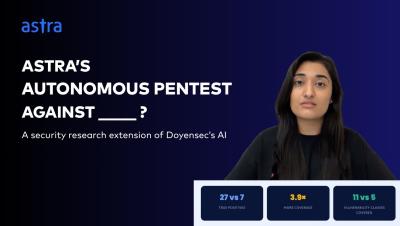
Astra's Autonomous Pentest Against Other Tool

Astra vs. Other Tool: Who Finds More Real Vulnerabilities? How does Astra Autonomous Pentesting compare with the other tool when it comes to finding real-world vulnerabilities? In this independent benchmark, Astra was tested against the other tool to evaluate vulnerability coverage, depth, and true-positive findings. The results: 27 true-positive vulnerabilities identified 3.9× more vulnerability coverage 11 distinct vulnerability classes discovered Deep testing across business logic and application behaviour.

How to Create a Hyper-V Virtual Switch | External, Internal & Private Switches

Hyper-V Virtual Switches are essential for connecting virtual machines to networks and managing communication between Hyper-V VMs, the host, and external networks. In this video, learn about the different types of Hyper-V Virtual Switches and when to use each one: External Virtual Switch – Connects VMs to the physical network Internal Virtual Switch – Enables communication between VMs and the Hyper-V host Private Virtual Switch – Enables communication between VMs on the same host.

Reconciling an AI Risk Estimate Against What Truly Happened

A model produces a figure, an event happens, and somebody asks whether the figure was right. It is the obvious question and it has almost no published answer, because the comparison is harder than it looks. ‍ A single realized loss cannot falsify a distribution. If a model puts a one percent chance on exceeding a threshold and the threshold is exceeded, the one percent case occurred, which is what the model said would sometimes happen. ‍

The Cyber Risk Inputs That Move the Answer Most

A cyber loss model has dozens of inputs and every one of them can be argued about. Record counts, downtime costs, control effectiveness, secondary loss factors, event likelihoods. ‍ A few of them determine the answer and the rest barely move it. Knowing which is which tells you where estimation effort belongs, and more usefully which disagreements about the model are not worth having. ‍

PCI DSS Continuous Compliance: How to Keep Payment-Page Controls Working Between Audits

At the 2026 PCI SSC North America Community Meeting in Vancouver, continuous compliance was a recurring theme: how do organizations move beyond point-in-time validation and keep security controls working as their environments change? For payment-page security, that question is especially practical. Your last assessment captured your environment at a point in time. Since then, a release may have added a checkout dependency. A vendor may have updated its JavaScript. Marketing may have changed a tag.

Building for the Future: Why We're Doubling Down on Customer Experience at Brivo

One of the earliest business lessons I learned is the importance of taking exceptional care of customers. Focusing on a positive customer experience is a commitment and a business success strategy I’ve followed at Barracuda Networks, Eagle Eye Networks and now here at Brivo. Customers value a real person answering the phone, knowledgeable technical support, and professionals with regional and vertical market expertise.

Emerging Threat: (CVE-2026-86858) ServiceNow AI Platform Unauthenticated Privilege Escalation via GraphQL

CVE-2026-86858 is an improper access control flaw in the ServiceNow AI Platform, classified as CWE-284. ServiceNow describes it as an unauthenticated privilege escalation reachable through GraphQL. In certain circumstances an unauthenticated user can create, modify, or delete instance data beyond what was intended. The vulnerability carries a CVSS v4.0 base score of 8.7 (High). Attack vector is network, attack complexity is low, and neither privileges nor user interaction are required.