Security | Threat Detection | Cyberattacks | DevSecOps | Compliance

Privacy in Enterprise AI: Why It's the Foundation, Not a Feature

Last week, OpenAI released Privacy Filter, an open-weight model for detecting and redacting PII in text. It is a thoughtful release: Apache 2.0 licensed, able to run locally, designed for high-throughput workflows, and built to go beyond regex-based detection. This is good news for everyone building enterprise AI. Privacy at the model layer is getting real attention. What we liked most was how clearly OpenAI described the role of the model.

What Is Generative AI Security? Key Risks and How to Fix Them

Generative AI security is the practice of protecting the data that flows into AI systems, and the outputs those systems produce, from leaks, attacks, and unauthorized access. Every organization using AI today has the same blind spot. Sensitive data enters an AI pipeline, and most security teams have no visibility into where it goes next. An employee pastes a customer record into ChatGPT. A developer submits code containing API keys to an AI debugging tool.

What Is AI Agent Security? Threats, Risks, and What Actually Stops Them (2026)

Over two-thirds of enterprises are already running agentic AI in production, according to a 2025 industry survey on the state of agentic AI security. Fewer than one in four have the visibility to know what those agents are actually doing. That gap is live right now, in systems handling customer data, financial records, and protected health information.

Types of AI Guardrails and When to Use Them (2026)

The types of AI guardrails are input guardrails, output guardrails, security guardrails, ethical guardrails, and operational guardrails, each positioned at a different failure point across an inference pipeline. Gartner’s research found that 30% of generative AI projects don’t survive past the proof-of-concept stage, with weak risk controls cited as the leading reason. Most of those projects weren’t badly built. The models worked. The gaps were in what sat around them.

What Is AI Context Security?

Every enterprise wants to use AI on its most valuable data — customer records, financial documents, clinical notes, legal files, engineering IP. The problem is simple: the moment that data enters an AI workflow, traditional security stops working. Firewalls protect the network. Encryption protects data at rest. Access controls protect the database. But none of them protect what happens when an AI agent retrieves five documents, synthesizes an answer, and delivers it to a user.

How to Secure AI Agents Accessing Enterprise Data: A Complete Guide

Artificial intelligence is changing how a business handles its operations, and that too very rapidly. AI agents can easily read, analyze, and act on enterprise data in real time. This ease also brings serious risk. If not managed well, these systems can expose sensitive information, break compliance rules, or even make harmful decisions. Did you know that on average, the overall cost of a data breach reached $4.45 million in 2023?

7 Generative AI Security Risks and How to Defend Your Organization

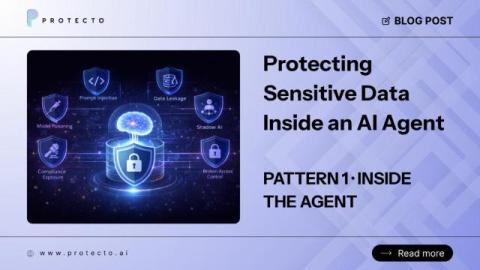
Generative AI creates new attack surfaces that traditional security tools were not designed to address. The biggest generative AI security risks include prompt injection, data leakage, shadow AI, compliance exposure, model poisoning, insecure RAG pipelines, and broken access control. Each one requires a specific defense, not a generic firewall or DLP rule.

What is the NIST AI Risk Management Framework?

The NIST AI Risk Management Framework is a guide that helps organizations spot and reduce risks in AI systems. This framework was released in January 2023 by the U.S. National Institute of Standards and Technology. The framework is built around four key steps, namely: Govern, Map, Measure, and Manage, and is meant to help teams responsibly use AI. It doesn’t matter which industry you work in or which AI you use; this framework works everywhere.

RBAC vs CBAC: Key Differences, Benefits, and Which One Your Business Needs

When businesses grow, managing who can access what becomes serious business. One wrong access permission can lead to data leaks, compliance penalties, or financial damage. In fact, IBM’s Cost of a Data Breach Report 2024 found that the average global data breach cost reached $4.88 million, the highest ever recorded. These numbers necessitate the requirement of having strong access control in place.