Security | Threat Detection | Cyberattacks | DevSecOps | Compliance

Frontier AI and the Demise of Hardware Security

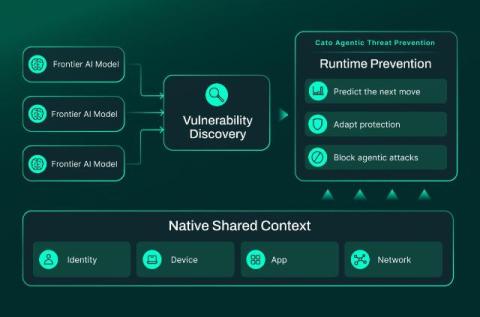
The cybersecurity industry has long relied on a simple idea: find vulnerabilities, patch them, and measure success by how fast you close the gap. “Time-to-patch” became a badge of honor. That model no longer holds. The rise of Mythos-class Frontier AI Models introduces a different kind of threat. AI-driven, agentic attacks operate continuously, discover weaknesses automatically, and execute at a scale no human team can match.

Audit Ready by Design: Continuous Compliance Posture You Can Prove

Think of your environment like a medical clinic. Patients with new “symptoms” show up every day, such as an overly permissive firewall rule or a missed TLS inspection policy. A good doctor triages the most severe case and prescribes the right fix before the “symptoms” escalate.

Beyond Patch SLAs: Continuous Protection in the Frontier AI Era

Frontier AI is changing the economics of cybersecurity. Advanced models can accelerate vulnerability research, exploit-path analysis, attack planning, and disclosure workflows, making vulnerability discovery more continuous, automated, and AI-driven. This raises the bar not only for enterprises that need faster protection, but also for cybersecurity vendors that must adapt secure development, production security, runtime validation, incident response, and AI-assisted workflows to keep pace.

Threat Brief: CVE-2026-41940: Critical cPanel & WHM Authentication Bypass Actively Exploited in the Wild

CVE-2026-41940 is a critical authentication bypass vulnerability in cPanel & WHM, including DNSOnly, and WP Squared. The issue affects cPanel software versions after 11.40 and can allow an unauthenticated remote attacker to gain unauthorized access to exposed hosting control panels. cPanel released patched versions and published official remediation and detection guidance.

Cato Joins OpenAI's Trusted Access for Cyber (TAC) to Advance AI-Driven Defense

Over a decade ago, Cato Networks helped shift cybersecurity to a new frontier: a converged, cloud-native platform that combines security and networking. As a long-time security researcher, the Cato platform was a radical change, providing researchers with the rich context and end-to-end visibility we needed to identify threats faster and deliver accurate protections.

Cato CTRL Threat Research: New Vulnerabilities in NVIDIA NeMo and Meta PyTorch Enable Full System Compromise

Cato CTRL has discovered high-severity vulnerabilities in NVIDIA NeMo (CVE-2025-33236 with a CVSS score of 7.8) and Meta PyTorch that turns AI model files into remote code execution (RCE) vectors. The NeMo vulnerability allows RCE by importing a malicious AI model. The NeMo framework silently executes threat actor-controlled code with no warning.

Global Campaign Discovered with Modbus PLCs Targeted and China-Geolocated Infrastructure Observed

From September – November 2025, Cato Networks threat researchers observed a global campaign involving suspicious Modbus/TCP (transmission control protocol) activity against internet-exposed PLCs (programmable logic controllers). The targeted footprint spanned 70 countries and 14,426 distinct targeted IPs, with the largest share of activity in the United States.

Eliminating Enterprise Browser Complexity in the Age of Universal ZTNA

Enterprises don’t struggle with whether users should have access. They struggle with how that access happens and how to secure it without creating more complexity. Employees work from managed laptops, personal devices, and third-party systems. Contractors need fast onboarding. Partners can’t install agents. Some users rely entirely on a browser. This mix isn’t temporary; it’s how modern enterprises operate.

SOC 2 Type II + HIPAA Attestation: Trust You Can Audit, Not Just Accept

There’s a little neighborhood coffee shop I love that runs like a Swiss watch. Every night, the owner doesn’t just flip the sign to “Closed.” They run a checklist: count the till, lock the back door, log fridge temps, sanitize the espresso wand, test the alarm, and write it all down. Not because they expect trouble, but because consistency is foundational to security. The shop earns trust the boring way: by doing the right things, repeatedly, even when nobody’s watching.