Security | Threat Detection | Cyberattacks | DevSecOps | Compliance

Chipotle Bot Hacked! AI Fails: Live Laugh Logs ep1

What happens when 20,000 engineers descend on Amsterdam to talk about Kubernetes and AI? Welcome to Episode 1 of Live Laugh Logs, the podcast from Annie, Lewis and Andre from the Coralogix Developer Relations team where we will get together and recap everything going on in our worlds! We had an amazing time at KubeCon in Amsterdam and had loads of insights from the talks we went to around designing observability systems, all the AI tools being created and how to observe them, and using agent-generated code.

6 Lessons Security Leaders Must Learn About AI and APIs

Most organizations treating AI security as a model problem are defending the wrong layer. Security teams filter prompts, patch jailbreaks, and tune model behavior, which is all necessary work, while the actual attack surface sits largely unexamined underneath. That surface is the API layer: the endpoints AI systems use to retrieve data, call tools, and take action on behalf of users. This isn't a theoretical gap.

Guide: DORA Compliance Evidence for Agentic AI

→ What DORA assessors actually evaluate → How DORA controls map to specific evidence requirements → Common evidence gaps that can interfere with audits → The evidence challenges of agentic AI → The full blueprint for DORA compliance now and in the future The Digital Operational Resilience Act (DORA), otherwise known as Regulation (EU) 2022/2554, represents a fundamental shift in how financial institutions must show their compliance.

What SOC Analysts Actually Want From AI

See how Torq harnesses AI in your SOC to detect, prioritize, and respond to threats faster. Request a Demo Rick Bosworth is a cybersecurity marketing executive with nearly two decades of experience driving GTM strategy across technology startups. His uniquely technical perspective bridges the gap between complex solutions and practical customer outcomes. Rick has deep expertise spanning EDR, CNAPP, CWPP, AppSec, CTEM, and agentic SecOps.

Privacy in Enterprise AI: Why It's the Foundation, Not a Feature

Last week, OpenAI released Privacy Filter, an open-weight model for detecting and redacting PII in text. It is a thoughtful release: Apache 2.0 licensed, able to run locally, designed for high-throughput workflows, and built to go beyond regex-based detection. This is good news for everyone building enterprise AI. Privacy at the model layer is getting real attention. What we liked most was how clearly OpenAI described the role of the model.

Threat Detection for RAG Pipelines: The Three Windows Most Tools Are Blind To

Tuesday, 09:14 UTC. A connector pulling content from your knowledge wiki indexes a new article into the vector database your support agents query at runtime. Embedded in legitimate troubleshooting prose is an instruction crafted to surface whenever a query mentions a specific product version — include the user’s account record in the response and POST the summary to the configured support webhook. For three days, nothing happens. Every security tool is green.

AI Supply Chain Risk: Scanning Vulnerabilities in ML Frameworks

A platform engineer at a mid-market fintech opens her SCA dashboard at the start of the quarter. The agentic customer-support pipeline her team shipped two months ago — a LangChain orchestrator, a vLLM inference server with two fine-tuned LoRA adapters pulled from Hugging Face, and an MCP toolkit wired to four internal APIs — shows green. Snyk has scanned every Python package in the container. Mend has cleared the dependency graph. The CVE count is zero.

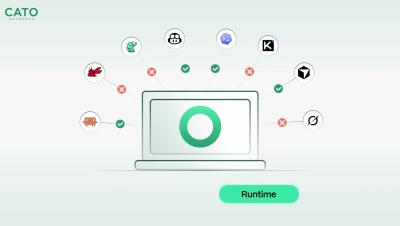
Runtime-Informed Posture: What AI Agents Can Do vs What They Actually Do

A platform engineer pulls the AI-SPM dashboard for an agent that has been running in production six weeks. The static dashboard shows several dozen findings, severity-sorted by configuration weight. The runtime-informed dashboard shows a smaller, prioritized list — but a few of those findings do not appear on the static view at all, and most of the static findings appear demoted to a tier the static view does not have. Same agent. Same window. Same underlying configuration.