Security | Threat Detection | Cyberattacks | DevSecOps | Compliance

Observability and Security for the AI Era

Datadog has always been driven by a broader vision of helping teams understand and operate complex systems. In this session, you’ll hear from Yrieix Garnier, VP of Product, and Hugo Kaczmarek, Senior Director of Product, as they share the latest updates across the Datadog product suite and discuss how that vision continues to shape the platform’s evolution and support the next generation of AI-driven applications.

BewAIre: Detecting Malicious Pull Requests at Scale with LLMs

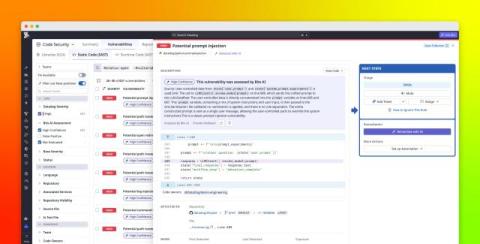
As AI coding assistants accelerate software development, the volume of pull requests at Datadog has grown to nearly 10,000 per week, increasing the risk that malicious changes slip through due to review fatigue. To address this, Datadog built BewAIre, an LLM-powered code review system designed to identify malicious source code changes introduced by threat actors. By reducing approval fatigue for developers while increasing friction for attackers, BewAIre guides human reviewers to the areas where judgment matters most, without slowing developer velocity.

What's new in Cloud SIEM: AI-powered investigations, enhanced threat intelligence, and scalable security operations

Security teams face a threat landscape shaped by AI-driven attacks and identity misuse. Adversaries increasingly rely on compromised identities to blend in as legitimate users, making attacks harder to detect and slower to contain. On average, organizations take 241 days to identify and contain a breach.1 While threats have evolved, legacy SIEMs have not kept pace.

How we centralize and remediate risks with Datadog Case Management

Proactively addressing risks in technical environments is a constant challenge. Many teams wait until it’s too late and key application functionality is disrupted or sensitive data is exposed. However, understanding risk severity in context can be difficult, especially in distributed systems where related issues and impacts may not be immediately obvious.

Accelerate incident response with Datadog and ServiceNow

For many organizations, ServiceNow operates as the system of record for governance, auditability, and compliance. But when incidents occur, engineers often need to consult external tools to identify and resolve the root cause. When investigations are siloed from the system of record, engineers must return to ServiceNow to manually update work notes, incident statuses, and mandatory resolution fields before closing tickets.

Protect your OCI resources with Datadog Cloud Security

Organizations adopt multi-cloud architectures for many reasons, including compliance requirements, business strategy, and resiliency. Regardless of the cloud provider, the security challenges remain the same: Identify the most critical risks, prioritize them with business context, and remediate them before they are exploited by a bad actor.

Amazon EC2 security: How misconfigured and public AMIs expand your cloud attack surface

Amazon Machine Images (AMIs) are templates for launching and scaling Amazon Elastic Compute Cloud (EC2) instances. Because Amazon EC2 AMIs are reused across environments and automation pipelines, decisions about how you build, source, manage, and share them directly affect your cloud attack surface.

Remediate transitive vulnerabilities faster with Datadog Software Composition Analysis

Security teams are responsible for finding and remediating vulnerable dependencies within applications that are built from large ecosystems of frameworks, SDKs, and utilities. What makes this task especially challenging is that these dependencies can pull in dozens or even hundreds of transitive dependencies through complex dependency chains. Even when scanners identify what’s vulnerable, teams still often lack the information they need about the dependency chain to safely address the issue.

Generate audit-ready vulnerability and compliance reports with Datadog Sheets

Security teams are frequently asked to provide clear, time-bounded evidence of their organization’s security posture. Whether the request comes from external auditors validating SOC 2, ISO 27001, PCI DSS, or internal governance reviews, they typically require collecting vulnerability data from multiple tools, reconciling resource lists, and manually generating spreadsheets for auditors. This process is slow, error-prone, and difficult to repeat consistently.

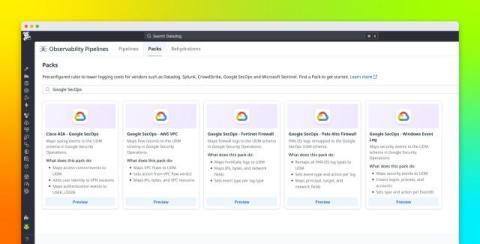
Enrich logs with ServiceNow CMDB context before routing to any SIEM or logging tool

Many DevOps and security teams rely on ServiceNow CMDB (Configuration Management Database) as the system of record for metadata about infrastructure assets, application and service ownership, and dependencies. ServiceNow CMDB captures which team owns each service, what business unit the service supports, the environment where it runs, and how assets relate to each other.