Security | Threat Detection | Cyberattacks | DevSecOps | Compliance

Streamline MSP operations: Application Control and OS Deployment features launched in Endpoint Central MSP Cloud

The landscape of managed service providers (MSPs) is constantly evolving, demanding greater efficiency and robust security. Today, we’re thrilled to announce a significant leap forward in our cloud-based MSP software: the release of Application Control and OS Deployment features in Endpoint Central MSP Cloud.

What is IPv6? Why you need a smart, integrated IPAM for efficient IPv6 management

Imagine trying to cram a growing population into a city with a limited number of addresses—eventually, you’ll run out of them. That’s exactly what has happened with IPv4, the internet’s original addressing system. With every website, smartphone, laptop, smart TV, and IoT device needing an IP address to connect to the internet, we’ve officially exhausted all 4.3 billion IPv4 addresses!

Episode 18: The Alliance Blueprint- How Partnerships Outsmart Cyber Threats ft.Sharada Murthy

In this episode, we invite Sharada Murthy to talk about identity and access management. We talk about the partner channel network and how shared intelligence can be a boon to organisations, password synchronisation vs. password pass through, cybersecurity and a lot more! Tune in right now to listen to the whole conversation!

Identity security and privileged access essentials for NIS2 compliance

With threat actors always on the edge, international organizations and regional governments have taken it upon themselves to mandate security standards and IT requirements to organizations under their jurisdiction. The European Union's NIS2 Directive disrupted industry trends within Europe when it came into force. NIS2 offers several upgrades to existing regional legal frameworks. It further suggests enhancements to existing cybersecurity measures, especially identity and privileged access security strategies of organizations' IT portfolios.

What are static subnets? How do they help streamlining connections for devices?

Static subnets are the fixed range of IP addresses in the network that are assigned to select individual devices manually. Static subnets differ from dynamic subnets in one way: the IP address of static subnets is permanently assigned to devices, compared to dynamic subnets where the IP allocation varies from time to time and device to device.

The Log360 security platform: Thinking outside the logs

We’re excited to announce the evolution of our SIEM solution, Log360, into a unified security platform. ManageEngine Log360 has adopted an open API-compatible architecture, allowing for expanded capabilities, seamless integration, and the ability to customize both data reporting and the underlying framework. This upgrade empowers you to extend the solution beyond its predefined functionalities, helping you unify and streamline security operations.

DDI Central 5.1 is here! Supercharge your networks with more power, more control, less hassle

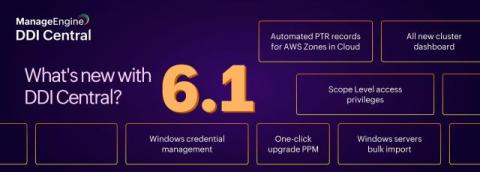
DDI Central has officially launched its latest version, 5.1 (Service Pack 5001), bringing a powerhouse of automation, real-time insights, security, and efficiency to DNS, DHCP, and IPAM (DDI) management. Packed with features and enhancements such as advanced REST APIs, WebSocket-based real-time collaboration, enhanced analytics, and intuitive tools, this update is designed to streamline network operations, enhance visibility, and drive network performance like never before.

Scattered Spider: Weaving an ever expanding web of cybercrimes

Imagine you are the owner of a bustling casino casually observing the vibrant scene: The clatter of slot machines, wagers are being placed, the cheerful chatter of gamblers, and waiters are serving cocktails. Everything appears normal until, without warning, the machines fall silent. However, it doesn’t stop there. Elevators grind to a halt, parking gates freeze shut, and guests find themselves locked out of their rooms as digital door keys fail to function.

Beyond the perimeter defense: How OpUtils elevates your network security posture

When networks were simpler, IT teams relied on firewalls as their primary defense, believing that securing the network perimeter was sufficient. However, as networks have grown in complexity—both horizontally and vertically-traditional security measures are no longer enough. The rise of remote work, cloud computing, layers of devices and applications, both evolved and primitive, and sophisticated cyberthreats has further emphasized the need for a more adaptive security strategy.