Security | Threat Detection | Cyberattacks | DevSecOps | Compliance

Ransomware protection for businesses and MSPs: the complete guide

Ransomware protection is a coordinated set of controls that reduces the likelihood of compromise, detects and contains malicious activity, protects recovery infrastructure and restores operations when an attack succeeds. It spans identity security, vulnerability and patch management, endpoint protection, EDR or XDR, incident response, targeted rollback, immutable backup and disaster recovery. No single control covers the complete ransomware lifecycle.

OpenTelemetry and AI Governance: Where the Standard Stops

OpenTelemetry graduated from the Cloud Native Computing Foundation in May 2026, which formally settled a question the industry had answered informally years earlier. It is the standard way applications emit telemetry, second only to Kubernetes in contributor volume, and native across every major observability backend. ‍ A security and governance company has a specific reason to care.

What an Open Control Weakness Costs You Every Month

Security programs price control work as an investment decision. What does the fix cost, what does it remove, does the return justify the spend. The framing answers whether to do something and says nothing about the cost of the interval before it gets done. ‍ An unimplemented control accrues expected loss for every month it stays unimplemented.

Application Layer Firewall: How It Works and Why It Matters

Your SOC dashboard shows a successful login from a normal user account. The connection uses HTTPS, the destination is an approved web server, and the network firewall allows it. Inside the request, however, an attacker has placed a SQL injection payload in a login parameter. Nothing is wrong with the perimeter firewall. It has been asked to answer a question it wasn't designed to answer.

SharePoint CVE-2026-55040 Actively Exploited: AI-Discovered RCE Chain

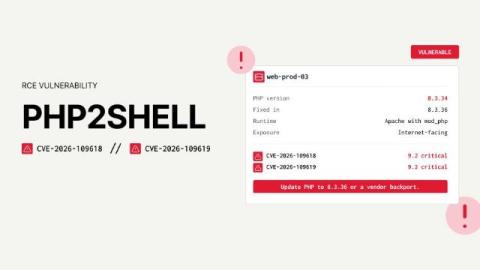
CVE-2026-55040, a critical SharePoint authentication bypass, is now being actively exploited. A proof-of-concept went public on August 11. Within 24 hours, threat intelligence firm Defused confirmed exploitation attempts against its SharePoint honeypots using that same PoC. Over 8,500 SharePoint servers remain reachable from the open internet, putting unpatched instances at immediate risk.

WhatsApp Usernames: Privacy Feature Brings New Impersonation Risks

WhatsApp has begun rolling out usernames, letting people connect without sharing their phone number. The feature adds privacy for individual users but opens fresh territory for impersonation, lookalike accounts, and smishing, particularly as usernames are reserved on a country-by-country basis.

How to Write a POA&M That FedRAMP Reviewers Accept

FedRAMP moved POA&Ms to agencies and replaced them with Accepted Weaknesses under the 2026 rules. Cloud providers must evaluate vulnerabilities in context (criticality, reachability, exploitability, detectability, prevalence, privilege, proximity, known threats), report results in JSON with PAIN N1–N5 ratings, and assume attacker automation. Remediate high PAIN, internet reachable risks fast; low PAIN risks can be accepted. Machine-readable data and platforms can help meet requirements.

AI Security Policy in Practice: How to Define What AI Can and Cannot Do

Most organizations that try to write an AI security policy start with two lists. Approved tools and banned tools. But, that list is inevitably out of date within a month. Employees adopt AI features embedded in everyday software faster than any review board can evaluate them, and a blanket ban does not stop the behavior, instead it pushes people toward personal accounts and unmanaged services.