Security | Threat Detection | Cyberattacks | DevSecOps | Compliance

Your CVE is reachable. But is it exploitable?

Any SCA tool worth its salt has reachability analysis these days. When a dependency has a known vulnerability, these tools can tell you whether your code calls the affected function. This is pretty much non-negotiable because it helps teams focus their security efforts instead of sifting through noise. Every other step in prioritizing dependency CVEs builds on it. But just because the vulnerable function is reachable doesn’t mean it’s exploitable.

MCP Database Security: Seven Boundaries Every AI Agent Needs

Connecting an AI agent to a production database can turn a slow investigation into a short conversation. The agent can inspect a schema, generate a query, and help explain a failed migration or an unexpected metric. The same connection can also expose sensitive records or modify production data if the access path is treated as a single trusted pipe.

AI guardrails aren't security controls

AI guardrails are sold as a solution to keep models behaving as intended - but it can be hard to figure out what you’re getting. The problem starts with the word itself. "Guardrails" means different things depending on who's selling them. Some vendors use it for simple prompt filtering, others bundle in entirely different controls and call it "guardrails" because the word sounds reassuring. Without a shared definition, buyers can't easily tell what they're actually getting.

Phishing Is Now A Criminal Impersonation Industry. Here Is How To Fight Back

For years, we described phishing as an email problem: an attacker writes a convincing message, sends it to thousands of people and waits for someone to click. That model is now outdated. Microsoft’s disruption of YAM Store, CoGUI and Iron Man exposed something much larger: a cloud-based impersonation industry.

Can Your ICT Vendors Put Your DORA Compliance at Risk?

Can your ICT vendors put your DORA compliance at risk? Even with strong internal cybersecurity controls, third-party ICT providers can introduce operational resilience risks that financial institutions cannot afford to overlook. Under the Digital Operational Resilience Act (DORA) financial entities must establish effective ICT third-party risk management practices, including vendor oversight, due diligence, contractual arrangements, ongoing monitoring and appropriate contingency planning.

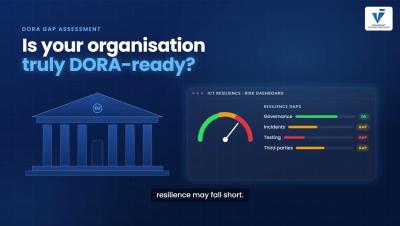
What Should a DORA Gap Assessment Include? Explained in 60 Seconds

Is your financial organisation prepared for the EU Digital Operational Resilience Act (DORA)? A DORA gap assessment helps financial entities identify weaknesses in their ICT risk management framework and understand what needs to be improved to meet applicable regulatory requirements. In this 60-second YouTube Short, VISTA InfoSec explains 5 essential areas to evaluate: ICT Risk Management – Governance, security controls, ICT assets and business continuity.

Expert panel: The AI agent has entered the chat

Every AI agent that acts on its own needs a login, access tokens, and permissions, which makes it a new kind of identity that has to be secured. Join our Notes From the Field panel for a live discussion of identity security. We’ll cover how attackers are using AI to target Active Directory and Entra ID, how to manage AI agents as identities, and which fixes defenders should prioritize.

Why Human-led Pentesting Still Matters in the AI Era & Should Be in Your Strategy

AI tools can scan an entire application in minutes. They flag known vulnerabilities, map attack surfaces, and generate reports that look thorough. So, it’s fair to ask whether human penetration testers are still necessary. They are.

Acronis Accelerate: Missed it? Now is your time to act

In May, Acronis introduced its vision for the future of IT. In July, we showed the progress. At the recent Acronis Accelerate: Time to Act event, we showed why now is the moment to start putting that future to work. Consider what is happening around us. Business AI adoption reached 47%. Codex surpassed five million weekly active users. Bots now generate roughly 57% of web requests. Gartner forecasts $2.7 trillion in worldwide AI spending this year.