Security | Threat Detection | Cyberattacks | DevSecOps | Compliance

The Latest Cybersecurity News & Insights From Around The World



The Convergence of Threats: Insights from the 2025 ENISA & Microsoft Reports
Muhammed Mayet, Global Sales Engineering Director, at Obrela elaborates on ENISA’s Threat Landscape 2025 and Microsoft’s Digital Defense Report 2025 and discusses how resilience can win over complexity The European Union Agency for Cybersecurity (ENISA), in its Threat Landscape 2025 report, paints a vivid picture of sustained and diverse cyberattacks across the EU.

Human Risk Multiplier: How Mobile Devices Expand Enterprise Attack Surfaces
Modern businesses are more reliant on mobile devices than ever before. Employees need smartphones and tablets for communication, productivity, and even security authentication. As remote and hybrid work setups become more common, mobile technology is necessary for keeping workers connected to their organizations. At the same time, these devices expose a weak link in the cybersecurity chain: the human layer.
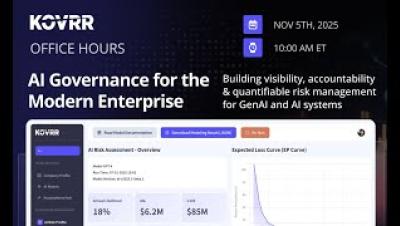
AI Governance & Risk Quantification for the Modern Enterprise
In this session, Or Amir, Product Manager at Kovrr, showcases our new AI Risk Assessment and AI Risk Quantification modules — helping enterprises gain visibility, benchmark maturity, identify shadow AI, and turn exposure into measurable outcomes.

Uncovering the Shadow AI Paradox
Does the world really need another study of shadow AI? That was my first thought going into this project. Reading dozens of previous reports did not change that impression: there's a lot of shadow AI out there, and a lot of reports saying so. But the more I read, the more apparent it became that something important was missing. This endless supply was not meeting what was actually in demand.

Unlock resilient growth: Master climate change risk in 2026
Climate change is no longer a distant threat; it has become a defining issue of our time. Rising global temperatures, unpredictable weather patterns, and shifting socio-economic landscapes are reshaping how businesses operate and how governments serve their constituents. In the midst of these enormous challenges, there is one undeniable truth: resilient growth hinges on the capacity to understand, manage, and adapt to climate change risk.

Scaling Exposure Management: Program Maturity and Continuous Optimization
Building an exposure management program is just the beginning of a long journey. True success comes from scaling that program through continuous optimization, measurable progress, and organizational alignment. As enterprises expand their digital footprint, exposure management must evolve from reactive vulnerability remediation to a proactive, data-driven discipline that continuously strengthens resilience.

The best vendor risk management software in 2025
For many organizations, vendor risk management (VRM) feels like an endless chase—gathering evidence, trudging through questionnaires, wrangling spreadsheets. Add expanding risk surfaces and new scrutiny from AI-driven regulations and customers, and it’s no wonder teams feel overwhelmed.

3 Truths About the Financial Sector's Digital Supply Chain Uncovered by Bitsight TRACE
When it comes to managing cyber risk, the financial sector is squarely at the top of the food chain. It’s simple economics (and the plot of many movies): financial institutions have the money, and cybercriminals are always looking for ways to take it. As a result, institutions have invested heavily in strengthening their internal systems and cybersecurity controls. Those investments have paid off.

It's time to rethink shadow AI.
It's time to rethink shadow AI. We've been told it's a fringe activity. A risk from rogue employees. Our new research proves that wrong. This is, ironically, no longer a "shadow" problem. It's a universal workflow hiding in plain sight. The question is no longer "how do we stop it?" It's "how do we manage it?" Our new report lands next week with the date you need to start answering that important question.