Security | Threat Detection | Cyberattacks | DevSecOps | Compliance

The Adversary's Speed Just Changed - What Mythos Means for Your Security Posture

The cybersecurity threat landscape just changed — and most organizations don't know it yet. In this conversation, Tanium's Pedro (CRO) and Mark Liu (VP of Solution Engineering) break down what Anthropic's Mythos really is, why security leaders everywhere are asking about it, and what organizations need to do right now. No marketing pitch — just a straight conversation about a consequential shift that's already underway.

Bot Management vs. ThreatX: How to Stop Business Logic Fraud

Bot Management vs. ThreatX: How to Stop Business Logic Fraud In this video, A10 Networks security expert Gary Wang explores the critical differences between dedicated bot management platforms and the ThreatX approach. If you are concerned about protecting your web applications from sophisticated fraud, this breakdown is essential viewing. Using a real-world scenario—a convenience store referral program being exploited by bad actors—Gary explains how attackers bypass standard defenses to commit "business logic" fraud.

Let's Talk Security: Operationalizing Zero Trust

In this conversation, Forescout CEO Barry Mainz sits down with Dr. Chase Cunningham, also known as “Dr. Zero Trust,” to unpack why Zero Trust is often harder to implement than expected in real-world environments. They also explore what changes when Zero Trust becomes universal (UZTNA)—extending across every connection, every asset, and every environment.

AI SecOps Worskhop Series: Detection Engineering with LimaCharlie and Claude Code

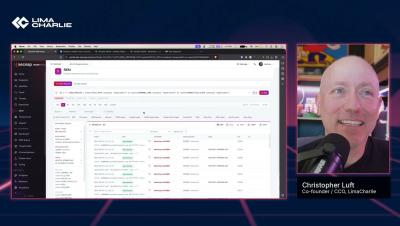
This hands-on workshop is designed for security professionals interested in learning how to integrate advanced AI capabilities into their detection and response workflows. Attendees will receive practical, step-by-step instruction on leveraging the power of Claude Code, a sophisticated AI agent, to significantly enhance security operations within the LimaCharlie platform for detection engineering use cases.

Are we blindly giving AI access to everything?

Users are connecting AI tools without understanding the security implications. In this week's Intel Chat, Chris Luft and Matt Bromiley discuss a security breach at Vercel that originated from a compromised third-party AI tool used by one of its employees. The attacker gained control of the employee's Google Workspace account, which provided access to Vercel's internal environment.

How multi-agent systems work in LimaCharlie

This video walks through how single agents and multi-agent systems are built and run inside the LimaCharlie platform. Agents in LimaCharlie are defined declaratively. Each agent specifies the model it runs, its instructions, the tools it can access, what events trigger it, and the guardrails it operates under. This approach makes agents version controllable, reviewable, and portable across tenants.

SMB Risks, AI, and Regional Realities with Paul Harris - The 443 Podcast - Episode 368

This week on the podcast, Marc and Corey sit down with Paul Harris, CEO of BGLA and Futurity Corp at WatchGuard's Impact Partner Conference in Tulum, to explore the evolving cybersecurity landscape across Latin America. Paul shares his journey from early days in cybersecurity to leading organizations in the region, while breaking down the biggest concerns facing LATAM SMBs today. The conversation also covers how AI is reshaping cybersecurity, the challenges of securing partners across diverse markets, and practical advice for business leaders looking to stay ahead of cyber risk in LATAM.

The Research Behind Of Detecting And Attributing LLM-Generated Passwords - Gäetan Ferry

GitGuardian Senior Cybersecurity Researcher Gaetan Ferry’s latest research shows that AI-generated passwords are leaving fingerprints in the wild. In this interview, he explains how he used Markov chains, a century-old statistical model, to detect patterns in passwords generated by modern LLMs, attribute them to model families, and identify 28,000 likely LLM-generated passwords across public GitHub. The findings are a warning for teams adopting AI coding agents.