Security | Threat Detection | Cyberattacks | DevSecOps | Compliance

Don't Pass on Combining iPaaS with a DFPM Platform

Businesses are under an ever-increasing pressure to maintain exceptional experiences for their customers, making seamless connectivity across tools a must. This is true for industries like financial services that need to provide enhanced digital payments, or for healthcare organizations that need to share critical data across systems quickly. The need for connected infrastructures has become the norm.

What is HIPAA and How to Become Compliant

HIPAA stands for Health Insurance Portability and Accountability Act. HIPAA is a U.S. law that was enacted in 1996 to protect sensitive patient health information from being disclosed without the patient's consent or knowledge and is enforced by the Department of Health and Human Services (HHS). The purpose of HIPAA is to protect the privacy of patients’ medical information and secure the handling of health information in the age of electronic health records.

Streamline Vendor Risk Management with the New Riscosity and ServiceNow Integration

Today, we’re excited to announce the launch of our integration with the ServiceNow Vendor Response Management (VRM) offering. Riscosity’s integration with ServiceNow empowers security teams with the insights and tools needed to achieve their security goals while still using their existing workflows in ServiceNow VRM.

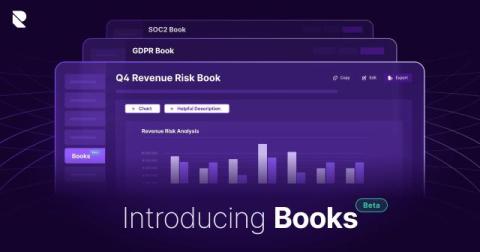
Introducing Books

The months leading up to audits can be some of the most stressful for security and privacy teams. Some audits can take up to 9 months to prepare for and another 3 months to complete, with security and privacy teams spearheading the evidence collection. Collecting evidence used to be a walk in the park, but that was before multi-cloud environments, new standards, and emerging regional privacy requirements.

AI Governance Belongs In Your Organization

In the modern workplace, GenAI models have become powerful assets due to their ability to introduce efficiency, up level product innovation, and expedite how teams close the gap on competitors. However, these powerful tools also introduce significant risks related to data security and governance. Companies that aren’t actively figuring out how to govern the GenAI they’ve adopted will inevitably be left vulnerable.

Data Catalogs: What They Are & Why They're Important

A data catalog is a critical data repository that enables visibility into what data you have, where it’s going, and who owns it – all critical inputs for maintaining data security. A company's data needs to be both organized and centralized, while also easily being discoverable. In this article, we’ll explore what data catalogs are and how they can create business value in your organization.

Riscosity Is Now Available on the AWS Marketplace

Starting today, Riscosity is available on AWS Marketplace, a digital catalog of software listings from independent software vendors that makes finding, testing, buying and deploying software that runs on Amazon Web Services (AWS) simple. This new partnership enables companies using AWS cloud services to easily purchase a Riscosity license directly from the marketplace, streamlining risk management and the deployment of Riscosity into their current security stack.

Data Governance: What It Is, It's Importance, and How To Get Started

A recent Gartner survey shared that, “61% of companies said their governance goals included optimizing data for business processes and productivity but only 42% of that group believed they were on track to achieve it.” Data governance is often viewed as a prohibitive, controlling, and time consuming process designed to slow down work. Traditional approaches to data governance can make it a complicated effort, detouring teams from implementing it, but it doesn’t have to be.

DFPM and DSPM: Two Steps Towards Modernizing Data Security

Data security is evolving. This evolution is making the need to understand what is going on with your data more critical. Teams need to be able to answer questions like, where is data being stored? Which vendor or team is using it? When is sensitive data being used? Where is data being sent?