Security | Threat Detection | Cyberattacks | DevSecOps | Compliance

The Next Generation of Full Stack Protection: Smarter Controls, Safer DeFi, and Full-Stack Protection

The crypto market has grown to over $3.2 trillion, driven by institutional adoption, stablecoin innovation, and a boost in DeFi activity. But every new dollar—and every new user—expands the attack surface potential. From credential stuffing and phishing, to malicious smart contracts and front-end exploits, today’s threat landscape is broader, faster, and more sophisticated than ever.
Fireblocks Enables Web3 Connectivity for Calastone's Industry-First Tokenized Fund Distribution Platform

Fireblocks is now working with Calastone, the largest global funds network, to support Web3 connectivity within Calastone’s Tokenised Distribution solution, a first-of-its-kind solution enabling asset managers to tokenize any fund on Calastone’s network and distribute it across blockchains such as Ethereum and Polygon. Fireblocks is providing secure infrastructure components that enable integration with Web3-native distributors.

Fintech 2.0: Why Banks Must Adapt or Be Left Behind

For banks, the question is no longer if they should act, but how fast they must adapt. Over the last two decades we’ve seen a meteoric rise of fintechs, starting as small startups focused on user acquisition and hypergrowth. Today, these same firms are maturing into sustainable, profit-generating businesses proving they’re here to stay; they are fundamentally reshaping the financial services industry.

Fireblocks Enables Web3 Connectivity for Calastone's Industry-First Tokenised Fund Distribution Platform

Fireblocks is now working with Calastone, the largest global funds network, to support Web3 connectivity within Calastone’s Tokenised Distribution solution, a first-of-its-kind solution enabling asset managers to tokenise any fund on Calastone’s network and distribute it across blockchains such as Ethereum and Polygon. Fireblocks is providing secure infrastructure components that enable integration with Web3-native distributors.

Japanese Megabank SMBC Leverages Fireblocks for Stablecoins

One of Japan’s largest banks is leveraging Fireblocks, alongside other technology providers, to explore stablecoin initiatives, dialing up momentum in the Japanese digital asset space. Fireblocks, Sumitomo Mitsui Banking Corporation (SMBC), Ava Labs, and TIS have signed a Memorandum of Understanding (MoU) to initiate joint discussions on the commercial use of stablecoins.

Charting the Course: How Paris Blockchain Week Mirrors the Path to Maturity of Digital Assets

I’ve returned from my fourth Paris Blockchain Week (PBW) with Fireblocks, which gives us a great opportunity to see how far we’ve come in the digital asset space. No longer a space for curious exploration, PBW is where we talk about implementation for mainstream adoption that’s happening today. And much like the industry, I’ve seen my own growth over the past five years at Fireblocks!

It's All About the Network-Welcome, Circle!

If there’s one truth in payments, it’s this: the network always wins. Think of what Visa and Mastercard created: not just payment rails, but global ecosystems of merchants, issuers, acquirers, and processors. Their networks didn’t just move money—they connected entire economies. As digital assets move into the mainstream, the same principle applies. But the networks of tomorrow won’t be built on closed systems and settlement delays.

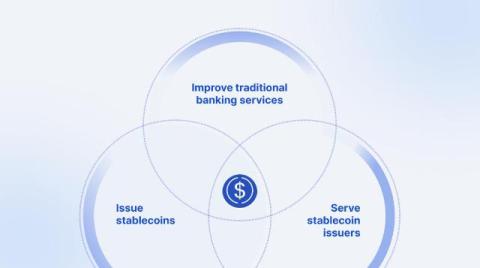
Unlocking Profit: How Bankers Can Harness Stablecoins for Revenue Growth

Brian Moynihan recently remarked, “It’s pretty clear there’s going to be a stablecoin… So if they make that legal, we’ll go into that business …it’s just then like another foreign currency.” While the comments from the CEO of Bank of America capture one bank use case for stablecoins, these digital assets have much more to offer banks than that.

Antagonistic Harmony: Permissioned and Permissionless Blockchains in Tomorrow's Financial System

The rise of blockchain has fundamentally reshaped the financial ecosystem. Since Bitcoin’s genesis in 2009, permissionless blockchains have introduced an open, decentralized model for transacting value—fueling everything from DeFi to NFTs. Meanwhile, traditional financial institutions (FIs), drawn to the benefits of blockchain yet cautious of its risks, have leaned into permissioned systems that offer control, privacy, and compliance.