Security | Threat Detection | Cyberattacks | DevSecOps | Compliance

How Blockchain Is Reshaping Banking Infrastructure

Blockchain adoption in banking is moving from experimentation to production. In this session, Fireblocks Financial Markets Economist Neil Chopra breaks down where banks, fintechs, and non-bank competitors are already live, what wallet infrastructure means for onchain ownership and control, and why stablecoins are proving the utility case that's pulling the rest of the market forward.

Wallet infrastructure is the new core banking layer

Owning the UI used to mean owning the customer. On blockchain, whoever controls the wallet controls the relationship. In this clip from the Banking Bootcamp, Fireblocks Financial Markets Economist Neil Chopra breaks down why wallet infrastructure is becoming the central layer for digital asset services at banks, and walks through the three use cases scaling in production today: custody and brokerage, stablecoin payments, and tokenization.

Why Stablecoins Need Infrastructure to Scale

Stablecoins are the obvious choice for cross-border payments. But scaling them means solving for interoperability across chains, stablecoins, and ecosystems, and integrating with the core banking and treasury systems institutions already use. In this clip from Fintech Fireside Asia, Dan Sleep, Head of Business Solutions APAC at Fireblocks, breaks down why infrastructure is the connective layer and how Fireblocks Network for Payments is bridging issuers, movers, and custodians across the value chain.

Institutional Crypto Liquidity: CME, Fireblocks & Cumberland | Consensus Hong Kong 2026

Why are institutions finally moving into crypto at scale? It's not just about the technology. At Consensus Hong Kong 2026, leaders from CME Group, Fireblocks, and Cumberland break down what's driving institutional adoption, where liquidity is flowing, and how the gap between TradFi and crypto-native markets is closing.

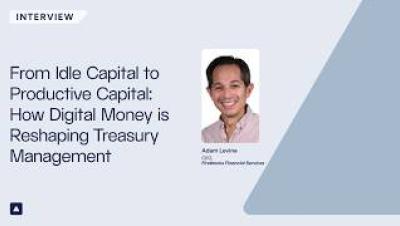
Adam Levine: How Banks Can Enter Digital Assets Without Replatforming | FINTECH.TV

Banks don't need to rip and replace their systems to capture the digital asset opportunity. Adam Levine, CEO of Fireblocks Trust Company and SVP of Corporate Development, sits down with FINTECH.TV's Remy Blaire at Ondo Summit 2026 to break down how traditional institutions can build foundational infrastructure while maintaining legacy rails. Timecodes Key Topics.

SPARK 25: Deribit Scales Crypto Options Infrastructure with Fireblocks

This is what crypto options infrastructure looks like at scale. Deribit needed to onboard custodians and expand collateral support without months of technical integration for each new relationship. Luuk Strijers, CEO of Deribit, knew they needed a partner with the security, flexibility, and network to scale faster without compromise. That partner was Fireblocks. Full wallet infrastructure across hot, warm, and cold storage Seamless expansion of collateral and coin support Frictionless custodian onboarding through Off Exchange.

Digital Asset Trading & Brokerage Services: How Banks are Building the Next Layer of Market Infrastructure

Banks make money from trading and brokerage. JP Morgan’s Markets division: $31 billion in 2024 and Goldman Sachs: $26 billion, according to private industry analysis. Morgan Stanley’s wealth division made $28 billion. Digital assets don’t change the role banks play to earn this revenue. In fact, they extend it. But activity is migrating. Coinbase generated $4 billion in transaction revenue in 2024, the same intermediation function banks provide.

Tokenization and Treasury: Practical Opportunities in Liquidity, Settlement, and FX Flows

Tokenization is moving from pilot to production. At the Singapore FinTech Festival 2025, industry leaders from Temasek, Fireblocks, Deutsche Bundesbank, and ADDX sat down to dissect the real-world momentum behind tokenized money, stablecoins, and programmable finance. From 24/7 liquidity and FX optimization to the rising role of TradFi in blockchain innovation, this panel explores what’s working now—and what’s holding tokenization back from truly scaling.

Inside Brazil's New Digital Asset Rules: What Institutions Need to Know for VASP Readiness

Brazil has formalized a comprehensive framework for virtual asset service providers (VASP). This is the moment when the rules become operational, enforceable, and aligned with the scale of activity taking place in the country. For institutions already active in Brazil and those evaluating market entry, this is a shift that raises expectations and lowers uncertainty at the same time.